Most ready mixed cleaning sprays are around ninety five per cent water. That water is bottled in plastic, transported by road, sold, carried home and eventually poured down a drain. Removing it is the clearest environmental improvement available in household cleaning, and it usually saves money too.
What formats exist?
- Dissolvable tablets – dropped into a reusable bottle of water. Minimal packaging.
- Concentrate sachets or small bottles – diluted at home into a trigger bottle.
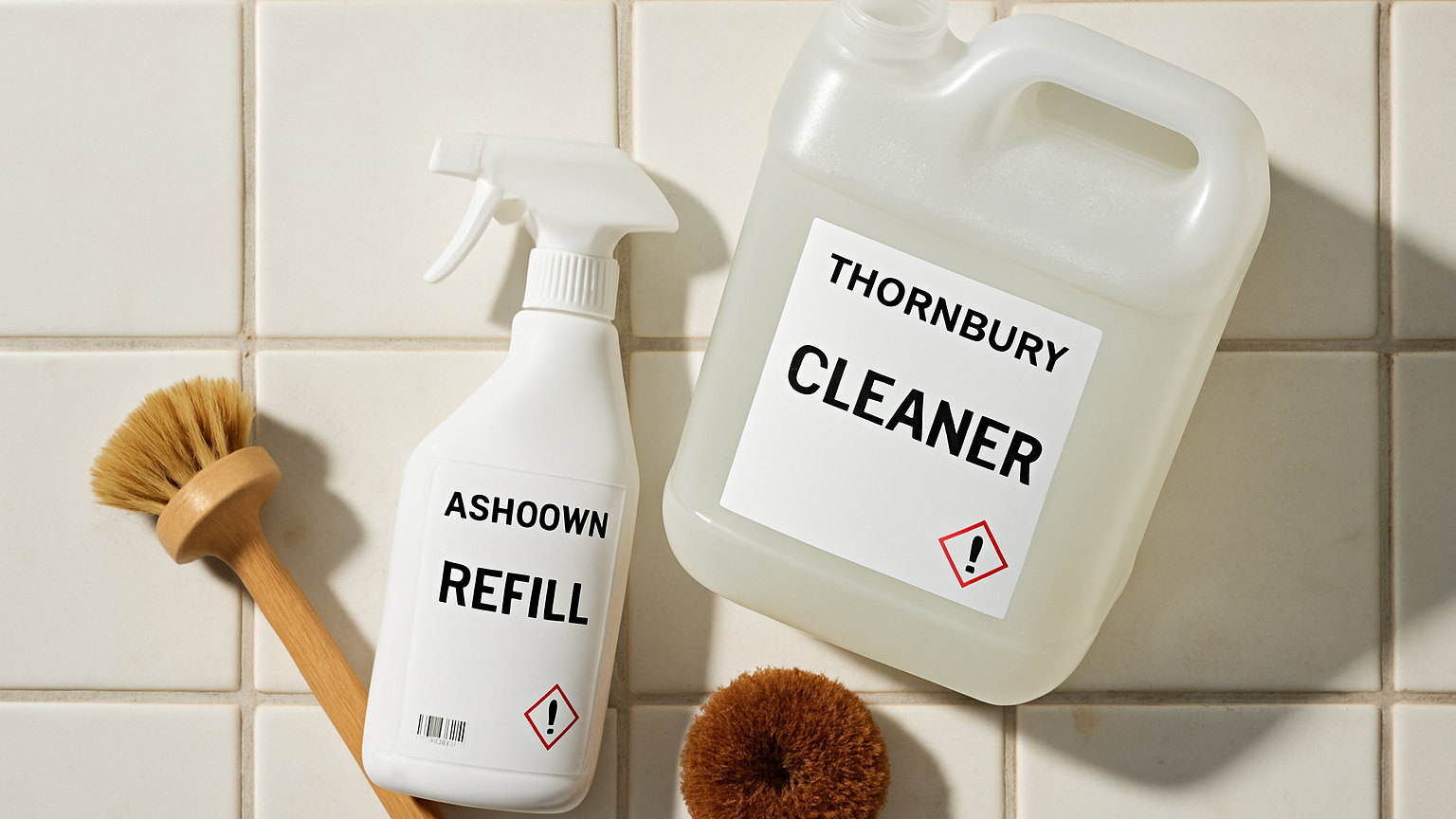
- Bulk refills – large containers used to top up smaller bottles.
- Refill shops and zero waste stores – bring your own container.
- Solid formats – bars, powders and blocks with no water at all.
- Subscription refill pouches – lighter packaging posted out.
How much does it save?
On packaging, a great deal. One trigger bottle reused for years replaces one bottle per purchase, and a tablet or sachet uses a fraction of the material.
On transport, the saving scales with the water removed. Shipping a concentrate that makes a litre instead of shipping a litre reduces the weight moved by roughly the same proportion.
Do they cost less?
Usually, and not always. Bulk refills and refill shops are generally cheaper per litre. Tablet systems from brands positioned as premium can cost more than a supermarket spray, since you are paying for the format rather than saving on it.
Compare the cost per made up litre rather than the price of the packet.
Do they work as well?
When diluted correctly, yes, since the made up product is the same chemistry. The variable is the dilution, and people frequently mix them stronger than directed, which wastes product and leaves residue.
Follow the stated ratio, which is usually weaker than instinct suggests.
What are the drawbacks?
Tablets take a few minutes to dissolve. Concentrates need measuring and a clean bottle. Refill shops require a trip and a container. Subscription systems can mean more deliveries.
None of these is significant, and they are the reason people abandon the format, so choosing one that fits your routine matters more than choosing the theoretically best one.
What about the trigger sprays?
The trigger mechanism is the least recyclable part of a cleaning bottle, containing a spring, a ball and several plastics. Reusing one for years rather than discarding it with each bottle is a genuine saving.
Rinse the mechanism through with warm water when changing product, run clean water through the tube, and relabel the bottle.
What about laundry and dishwashing?
Concentrated laundry liquids, powder in cardboard and laundry sheets all reduce packaging and weight considerably compared with large plastic bottles.
For dishwashers, tablets already avoid most of the water problem. Look at the wrapper instead, since some are individually wrapped in plastic and others use a dissolvable film.
Are dissolvable films a problem?
The polyvinyl alcohol films used on tablets and capsules do dissolve, and there is ongoing debate about how completely they biodegrade in wastewater treatment. It is an area where the evidence is still developing.
Powder in cardboard avoids the question entirely and is usually cheaper.
What is the easiest place to start?
Keep the trigger bottles you already have, wash them out, and buy concentrate or bulk refill for the two or three sprays you use most. That requires no new system and removes most of the packaging immediately.
Is it the biggest change you can make?
For surface cleaning, close to it, alongside using less. For laundry, washing at a lower temperature and running full loads matters more, since the energy to heat water dominates the impact.
How do you dilute a concentrate accurately?
Mark the bottle rather than guessing. Fill it with water to the level you want, mark it with a permanent pen, and use that line every time. Most people over-concentrate when mixing by eye, which wastes the product and leaves residue on surfaces that then attracts dirt.
Do they store well?
The concentrates and tablets generally keep for a long time, since there is little or no water in them. The made up solution keeps less well, particularly if mixed with warm water, so make up one bottle at a time rather than several and use it within a few weeks.