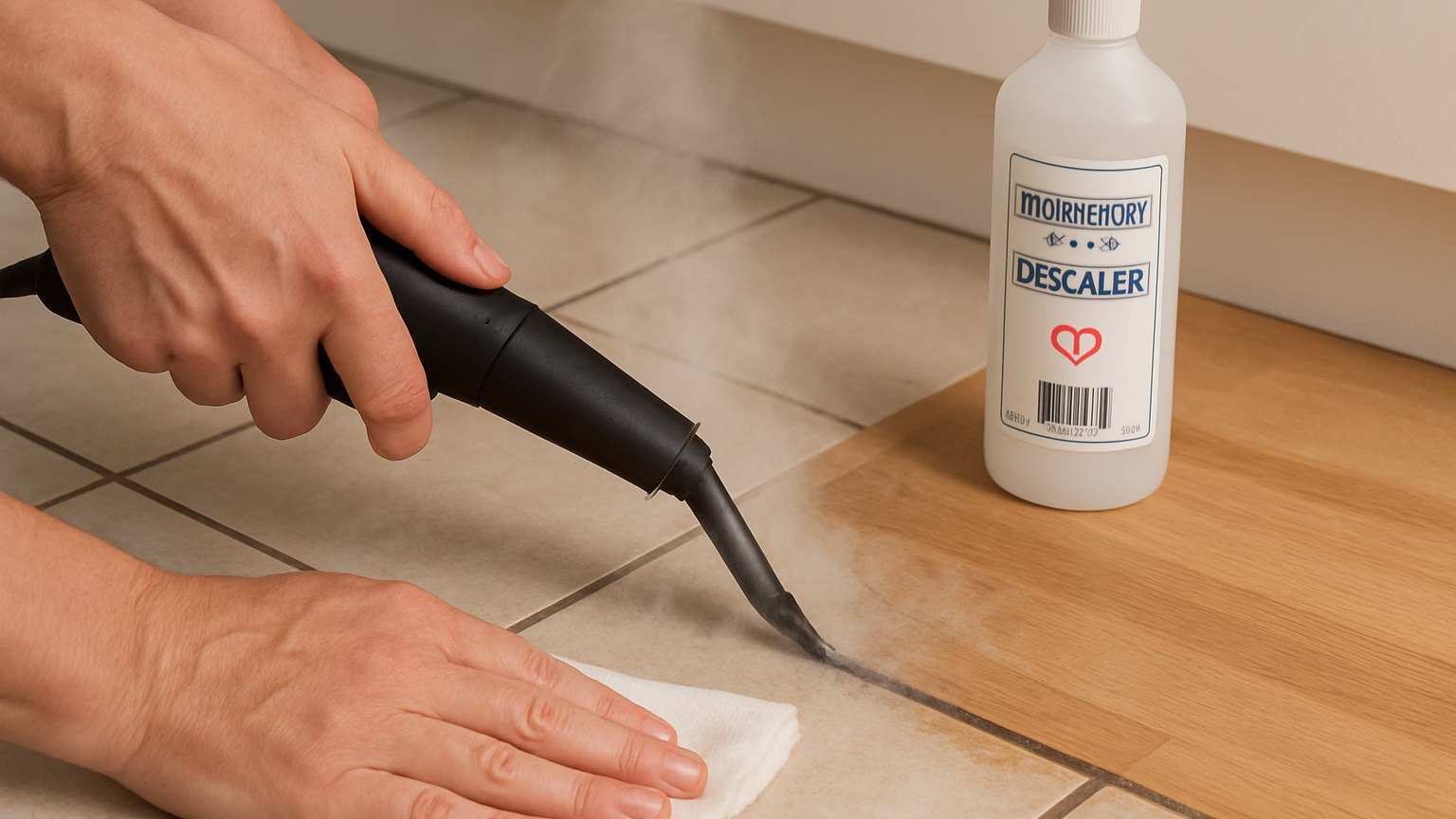
A steam cleaner boils water and releases the steam, leaving every dissolved mineral behind in the boiler. In a hard water area that builds into a layer of scale within months, which insulates the heating element, blocks the jets and eventually ends the machine.
What does scale do?
- Insulates the element, so it takes longer to heat and uses more electricity.
- Blocks the nozzle and jets, giving weak or intermittent steam.
- Reduces pressure and therefore cleaning performance.
- Flakes off into the steam, spitting white deposits onto surfaces.
- Causes the element to fail eventually, which usually ends the machine.
Should you use distilled water?
In a hard water area, yes, and most manufacturers recommend it. Distilled or deionised water contains no dissolved minerals, so nothing is left behind and the boiler stays clean indefinitely.
Filtered water from a jug filter helps and does not remove the minerals entirely, so it slows scaling rather than preventing it.
In a soft water area, tap water is usually fine. Check the manual, since some machines specify distilled water regardless.
How do you descale it?
- Check the manual first, since some machines have a specific procedure or forbid descaling entirely.
- Let the machine cool completely and unplug it.
- Empty the boiler.
- Fill with a solution of citric acid in warm water, roughly one to two tablespoons to a litre.
- Leave it to stand for thirty minutes to an hour without heating it.
- Empty, then rinse two or three times with clean water.
- Fill with clean water, heat and run the steam out through the nozzle to clear the lines.
White vinegar works similarly and leaves a smell that takes several flushes to clear. Citric acid is cleaner for this.
Should you heat the descaling solution?
Only if the manual says so. Some manufacturers advise against running acid through the system under heat, since it can attack seals and internal components. Soaking cold is the safer default.
Never use a proprietary kettle descaler unless the manual permits it, since concentrations vary.
How often?
In a very hard water area with tap water, every month or two. In a moderately hard area, quarterly. With distilled water, rarely or never.
The clearest indicator is performance: weaker steam, a longer heat up time, spitting or white deposits on surfaces all mean it is due.
How do you clear a blocked nozzle?
Soak the detachable nozzle and any attachments in a citric acid or vinegar solution for an hour, then clear the jet with a pin or a needle and rinse thoroughly.
Work gently, since enlarging or distorting the jet changes the spray pattern permanently.
What about the pads and cloths?
Scale flakes collect in mop pads and cloth covers and are then dragged across the floor. Wash them at sixty degrees with no fabric conditioner, and check them for grit before use.
How should it be stored?
Empty and dry. Water left standing in a boiler between uses contributes to scaling and corrosion, and in a machine used occasionally it can go stagnant.
Empty it after every session, leave the cap off until it has dried, then store it somewhere it will not freeze.
What if it has never been descaled?
Repeat the soak two or three times rather than using a stronger solution. Heavy scale releases in layers, and a stronger acid risks the seals.
If performance does not recover after three attempts, the element is probably coated beyond recovery, which is usually the end of a domestic machine.
Can you tell how much scale there is?
Partly, and the signs are easy to read once you know them. Pour the emptied water into a clear container and look for white flakes or grit in the bottom, which shows that scale is already breaking loose inside. A boiler that rattles slightly when the machine is moved, or one that takes noticeably longer to reach temperature than it did when new, are both reliable signs that there is a substantial layer built up on the element.