A pet accident on a mattress combines every difficulty at once. The liquid soaks deep into foam or springs, it cannot be rinsed out, the treatment that works needs to stay wet for a while, and the whole thing takes days to dry. Getting a good result depends on balancing enough enzyme cleaner to reach the residue against not saturating something that cannot be dried easily.
What should you do immediately?
- Strip the bed and get the bedding into a cold soak.
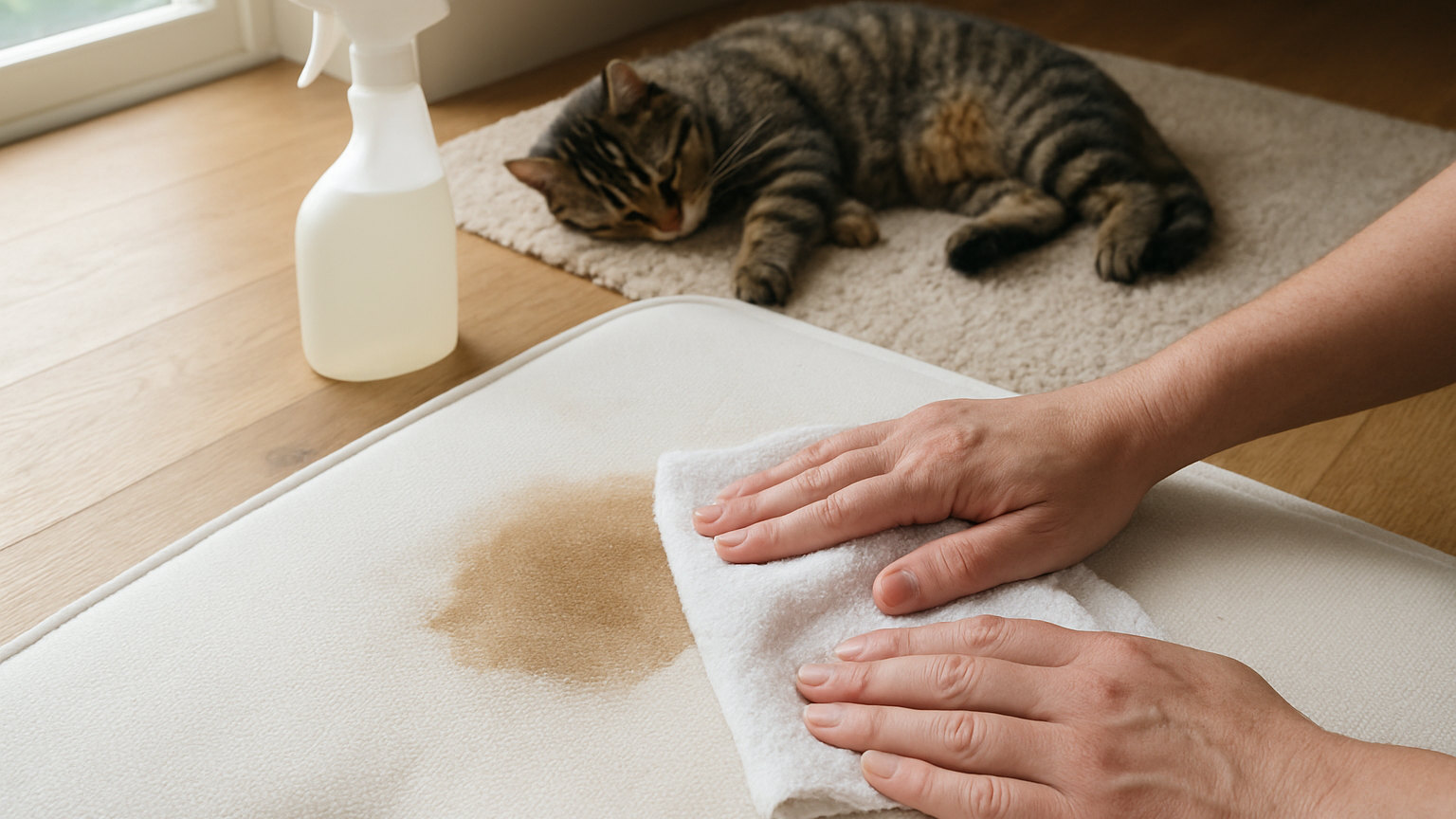
- Press dry towels down hard onto the mattress, repeatedly, to draw liquid up.
- Stand on the towels if necessary, changing to dry sections.
- Keep blotting until very little further transfers.
- Only then apply any treatment.
The blotting stage removes more than any product will, and it is the part people rush.
How do you apply an enzyme cleaner?
Generously enough to reach where the urine reached, which is deeper than the surface, and no more. Apply it, cover the area with a damp cloth so it does not dry out, and leave it for the full contact time on the label.
Then press dry towels down under weight for several hours to draw the moisture back out. That extraction stage is what keeps the mattress from staying wet.
Repeat the cycle rather than applying a larger volume at once. Two moderate treatments dry far better than one soaking.
What does bicarbonate of soda add?
Once the enzyme treatment has been blotted out and the area is damp rather than wet, cover it generously with bicarbonate of soda. It draws remaining moisture upwards as it dries and absorbs odour at the same time.
Leave it overnight, or for a full day, then vacuum it off thoroughly. This is the step that makes the difference between a mattress that is dry and one that smells faintly for a month.
Why does drying decide the outcome?
Because a damp mattress grows mould inside the foam, and that is a considerably worse problem than the original stain. Foam holds moisture well below the surface long after the top feels dry.
Stand the mattress on its side if you can, open the window, and direct a fan at the treated area for several hours. Do not remake the bed until the area is dry to the touch and still dry an hour later.
What about memory foam?
The least tolerant of moisture of any mattress type. Use the minimum enzyme cleaner that will work, extract aggressively with towels, and rely more heavily on the bicarbonate stage. Allow considerably longer for drying, with a fan running throughout.
Memory foam that has been soaked and dried slowly frequently smells permanently, which is why a protector matters more here than on any other mattress.
What should never be used?
- A steam cleaner, which sets the proteins and adds moisture.
- Hot water, for the same reason.
- Chlorine bleach, which reacts with urine to produce harmful fumes and damages the ticking.
- Ammonia based cleaners, which encourage the animal to return.
- A large volume of any liquid.
What about the stain that remains?
A yellow shadow often stays after the smell has gone, and on a mattress that is a reasonable outcome since it is covered in use. A dilute hydrogen peroxide solution dabbed on lightly will lighten it, tested first at the edge, and applied sparingly given the drying problem.
What prevents a repeat?
A waterproof mattress protector, which takes the accident instead and goes in the machine at 60 degrees. Where a pet sleeps on the bed regularly, a washable blanket over the top adds a second layer that can be changed weekly.
A sudden accident from a previously reliable animal is also worth a vet call rather than only a cleaning response.
When is a mattress beyond saving?
When the smell persists after two full treatments and proper drying, which usually means the liquid reached the core. At that point the residue is deeper than any surface treatment can reach, and continuing to wet it causes more harm than good. Replacing a mattress is expensive and so is sleeping on one that smells, and a protector on the replacement prevents a repeat.