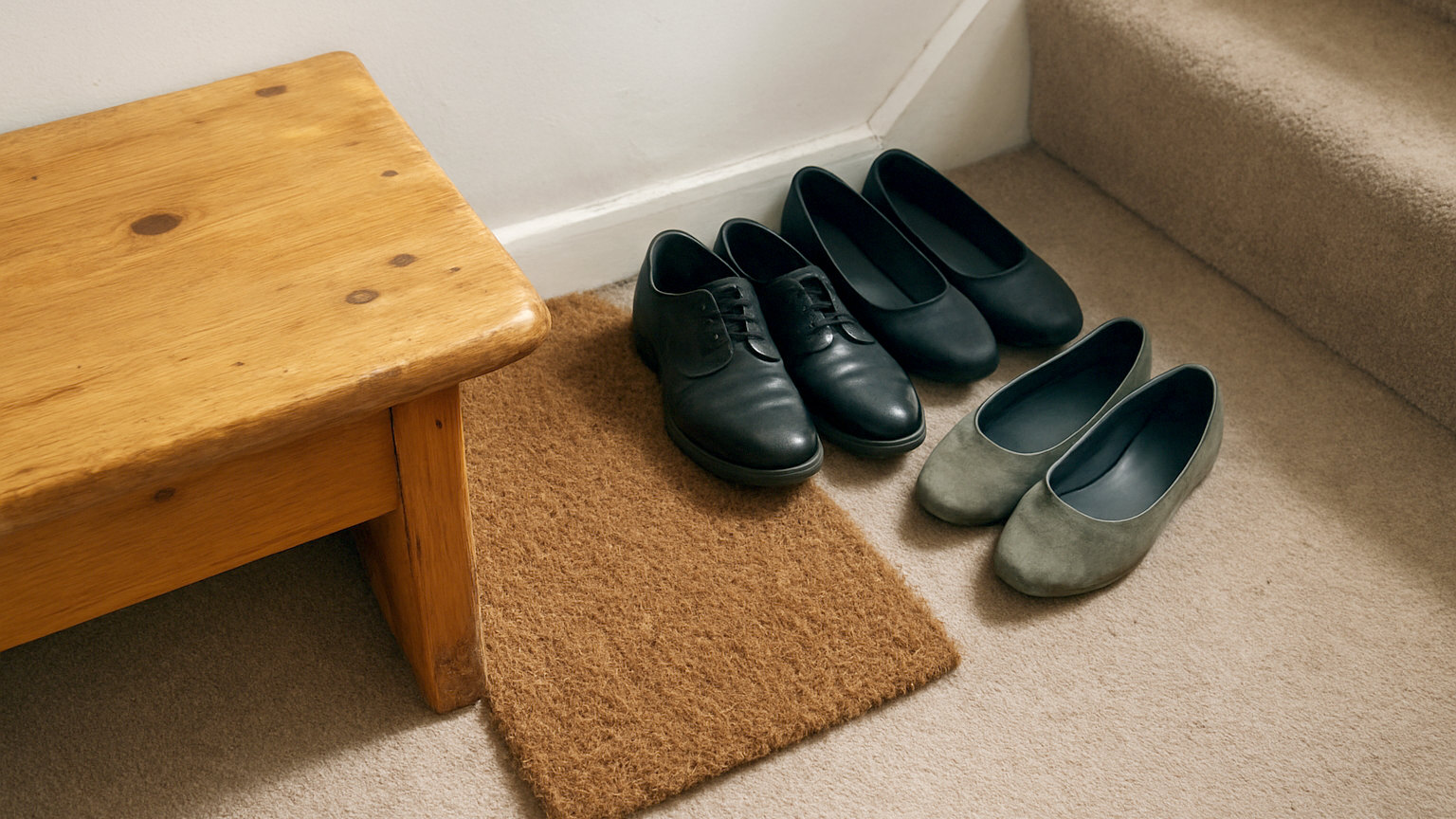
Most doormats are chosen for how they look and are far too small to do anything useful. A mat needs to take several footfalls to capture a meaningful amount of what is on a shoe, and a small square that catches one step is largely decorative. Length is the variable that matters most, ahead of material, thickness or price.
How big should a doormat be?
Long enough for at least two full steps with each foot, which in practice means a metre or more. Commercial entrances use several metres for exactly this reason. At home the usual compromise is a scraper mat outside and a long absorbent runner inside, giving three or four footfalls in total.
Width matters too. A mat narrower than the doorway means people step around the edges of it.
What is the difference between a scraper and an absorbent mat?
They do different jobs and a good entrance uses both.
- Scraper mats have a coarse, open surface – rubber ridges, bristles, metal or heavy coir. They remove heavy soil and grit and let it fall through, and they belong outside.
- Absorbent mats have a dense textile pile that holds water and fine particles. They belong inside, where moisture is the main problem.
Using an absorbent mat outside means a permanently saturated mat that does nothing. Using a scraper mat inside means grit falling through onto the floor beneath it.
Which materials perform best?
For outdoors, rubber and rubber-and-bristle combinations last longest and cope with rain. Coir is effective and looks right on a traditional entrance, but it rots when it stays wet and sheds fibres constantly.
For indoors, a dense polypropylene or nylon pile with a rubber backing performs best. It absorbs, it holds grit below the surface where feet cannot pick it back up, and it can be washed. Cotton mats absorb well but saturate quickly and need washing far more often.
Should it be washable?
Yes, and this is where a lot of mats fall down. A mat that cannot be cleaned easily will not be cleaned, and a full mat stops working entirely. Look for something that either fits in a domestic washing machine or can be hosed down and dried outdoors.
Check the backing before washing anything. Rubber backing degrades in a hot wash and in a tumble dryer, so cool wash and air dry is the safe default.
How often do they need cleaning?
Vacuum or shake the indoor mat two or three times a week, and more in winter. Wash it every four to eight weeks. Lift and brush the outdoor mat weekly and sweep the step underneath, since grit accumulates there and gets tracked straight back on.
The clearest sign a mat needs attention is when shaking it produces a cloud. At that point it has been full for a while.
Do the mats with a rubber backing damage floors?
Some do. Solid rubber backing on a vinyl or laminate floor can cause discolouration over time, particularly in sunlight, and a mat left permanently in one spot on a wood floor will leave a visible line where the surrounding area has aged differently. Lifting the mat when you vacuum and moving it slightly avoids both.
On a hard floor, check the backing is non-slip rather than simply heavy, since a mat that slides underfoot at the top of a step is a genuine hazard. Rubber backed mats grip well on tile and vinyl; a woven mat with no backing will move on almost any smooth surface.
What about mats with a recessed well?
A matwell – a recess set into the floor at the entrance that holds the mat flush – is the best solution available and worth considering if the floor is being replaced anyway. It allows a much thicker, more effective mat without a trip hazard, and the mat can be lifted out for cleaning. It is a small addition during a floor installation and impossible to retrofit cheaply afterwards.