Cleaning a painted wall is mostly an exercise in restraint. Matt emulsion, which is what most walls are finished in, has a porous surface with almost no protective film, and rubbing at it hard burnishes the paint into a shiny patch that catches the light. That patch is usually far more visible than the mark that prompted it.
What kind of paint is on the wall?
It determines everything you can do.
- Matt emulsion – the most common and the least washable. Very gentle cleaning only.
- Vinyl silk and soft sheen – a slight film makes them more tolerant of a damp cloth.
- Washable or scrubbable emulsion – formulated for exactly this and the most forgiving.
- Eggshell and satinwood – usually on woodwork, and durable enough for soapy water.
- Gloss – the toughest of all.
If you do not know which you have, assume matt and start with the gentlest approach available, escalating only if it fails.
What is the safe method?
- Test in a hidden spot first, behind a door or low down behind furniture.
- Start with a dry approach: a soft cloth, or a clean eraser for a pencil or scuff mark.
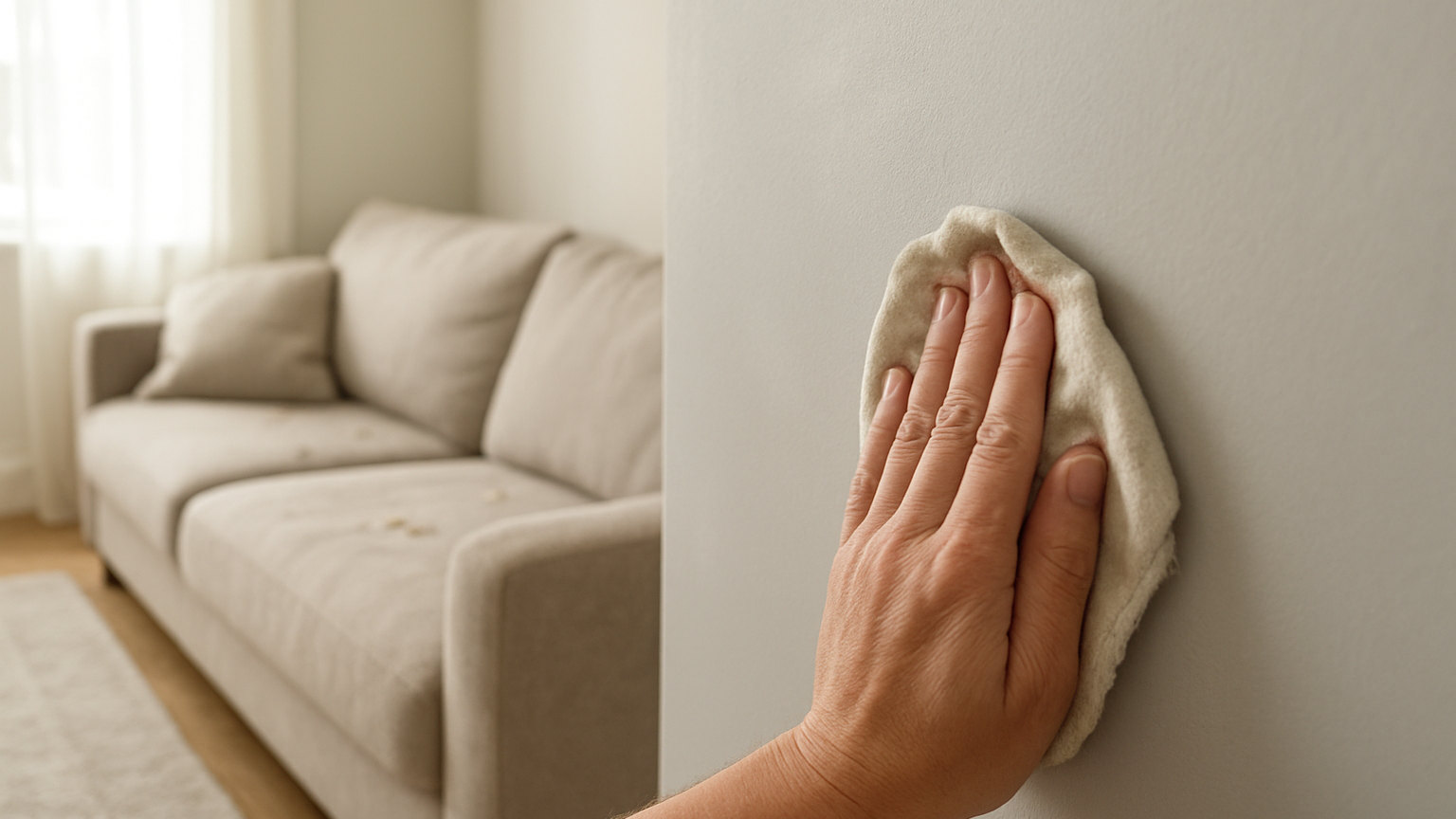
- If that fails, use a cloth wrung out in warm water with a drop of washing up liquid, barely damp.
- Blot and dab rather than rub. Pressure is what damages the finish.
- Work outwards from the mark, and feather the edges so there is no hard boundary.
- Dry with a clean cloth immediately.
What works on specific marks?
Scuffs from shoes and furniture often come off with a clean pencil eraser used lightly. Greasy fingermarks around light switches respond to a barely damp cloth with a trace of washing up liquid. Crayon can be lifted with a little bicarbonate of soda on a damp cloth, worked very gently. Sticky residue from tape usually needs patience and warm soapy water rather than a solvent, which will take the paint with it.
Mould spotting needs a fungicidal wash rather than ordinary cleaning, and the condensation causing it needs addressing separately, or it will simply return.
Is a melamine sponge a good idea?
It is effective and it is risky. A melamine sponge works by fine abrasion, which means it removes the mark and a thin layer of paint at the same time. On washable, silk or eggshell finishes it often works well and leaves nothing behind. On matt emulsion it very frequently leaves a dull or patchy area where the surface has been sanded away, and that patch shows up clearly whenever light crosses the wall at an angle.
If you use one, use it damp rather than wet, with almost no pressure, and accept that the area may need touching up afterwards.
When is touching up the better answer?
More often than people expect. A small dab of the original paint applied with a fine brush and feathered at the edges takes two minutes and gives a perfect result, while ten minutes of cleaning gives a burnished patch. This is the argument for keeping labelled leftover paint from every room.
Where no matching paint exists, repainting a whole wall from corner to corner is the only way to avoid a visible patch, since emulsion rarely matches exactly across batches and every wall fades a little with age and light. Keeping a labelled pot from each room, with the date and the finish written on the lid, turns a repaint into a two minute touch up for years afterwards.
How do you avoid the marks in the first place?
Wipe fingermarks around switches and door edges weekly while they are fresh, since a fresh mark lifts with almost no effort and a six month old one has bonded into the surface. Use washable emulsion in hallways, stairways and children bedrooms, where the difference in durability is substantial and worth the extra cost. Fit furniture stops or felt pads where chair backs meet walls, which prevents the most common scuff of all.