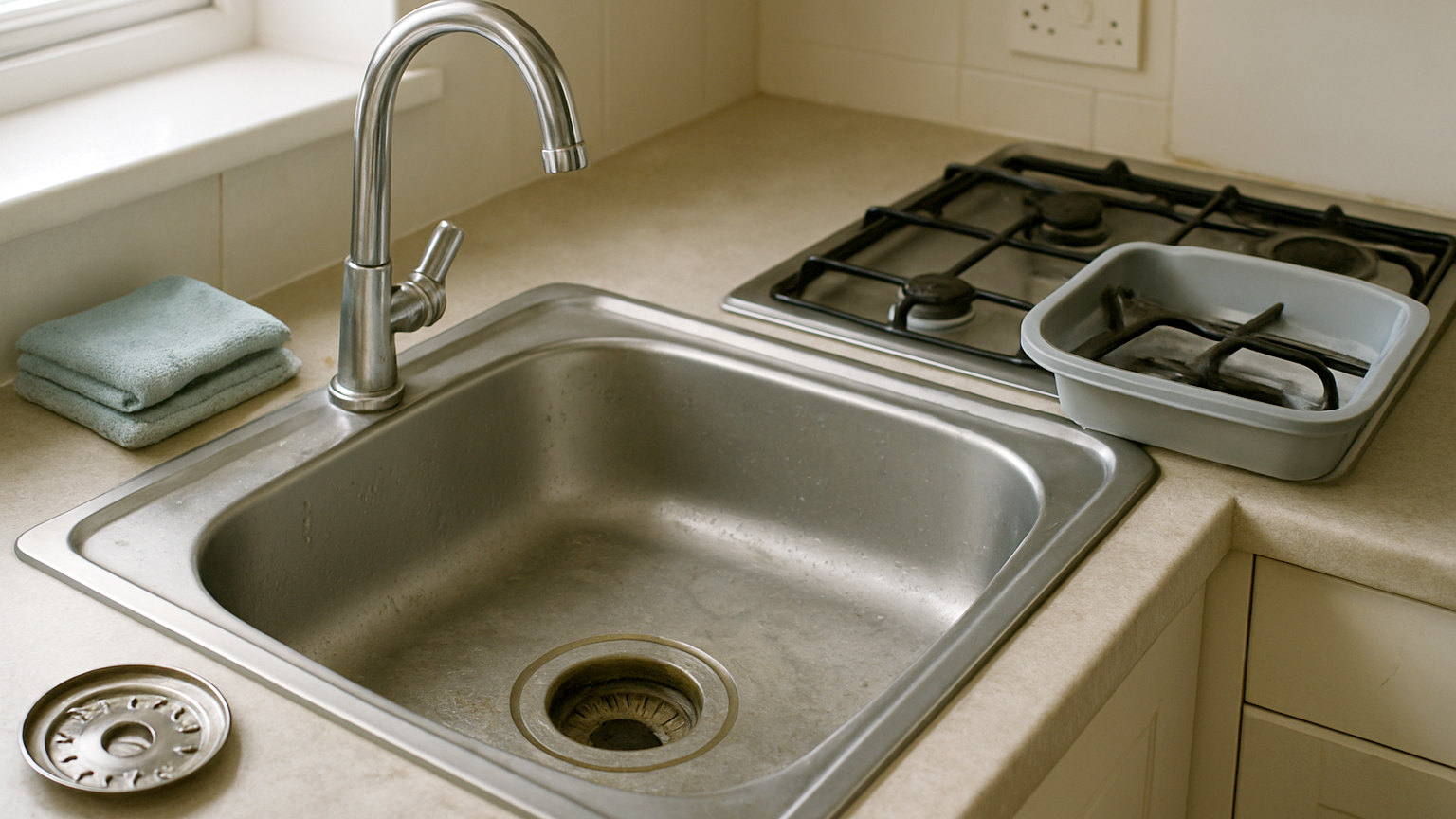
The kitchen sink is one of the dirtiest surfaces in a house, and usually dirtier than the bin, because it is wet, warm and in constant contact with food. Cleaning it properly takes about five minutes, but the part that matters most – the plughole and the overflow – is the part most people never touch.
Why is the sink dirtier than it looks?
Because bacteria need moisture and food, and a sink supplies both continuously. Rinsing a chopping board, draining pasta water and scraping plates all leave organic residue behind, and a sink that looks clean because it has been rinsed has simply had the visible material moved a few centimetres towards the drain. The biofilm that builds up around the plughole is where smells begin.
How do you clean it day to day?
Wash it, do not just rinse it. Once the washing up is done, use the hot soapy water that is already there and a cloth or brush to go round the whole bowl, the sides, the rim, the base of the tap and the plughole. Rinse, then dry with a cloth or a piece of kitchen paper. Drying is the step that prevents water marks and limescale, and it takes fifteen seconds.
What is the right method for each material?
- Stainless steel – wash with washing up liquid, then wipe in the direction of the grain. A cream cleaner deals with dull patches. Never leave bleach or salt sitting in it, and avoid steel wool, which leaves particles that rust and pit the surface.
- Ceramic – a cream cleaner or bicarbonate of soda on a damp cloth removes the grey marks left by pans without scratching the glaze. Abrasive powders will dull it over time.
- Composite and granite – washing up liquid for daily use, and a paste of bicarbonate of soda for staining. Avoid acidic descalers on anything containing natural stone unless the manufacturer says otherwise.
- Enamel – gentle cream cleaner only. Once the enamel is chipped or worn, staining is permanent.
How do you get rid of limescale and water marks?
Water marks are dissolved minerals left behind when water evaporates, so they are prevented by drying and removed by acid. On stainless steel, a cloth soaked in white vinegar laid over the scaled area for fifteen minutes will soften it enough to wipe away. On taps, wrap the vinegar-soaked cloth around the spout and secure it, since the underside of a tap is usually the worst affected part.
Do not use vinegar or limescale remover on natural stone, and keep it away from any coated or matt black tap finish, which acid can strip permanently.
Why does the drain smell, and how do you fix it?
Almost always because of a build up of grease and food residue inside the waste pipe or under the rim of the plughole, and occasionally because the trap has dried out. The fix that works is heat and detergent rather than a strong smelling product poured on top.
Pour a kettle of hot water down the drain with a good squeeze of washing up liquid, wait a few minutes, and follow it with a second kettle. Repeat weekly if the sink is used heavily. For a build up you can feel, scrub under the plughole rim with an old toothbrush, and clear the overflow with a bottle brush, because it fills with slime and is invisible from above.
Bicarbonate of soda followed by vinegar makes a satisfying fizz but achieves very little in a drain, since the two neutralise each other. The mechanical scrubbing and the hot water do the work.
What should never go down a kitchen sink?
Fat and cooking oil, which solidify in the pipe and catch everything else that follows. Coffee grounds, which compact. Rice and pasta, which swell. Let fat cool and put it in the bin, and wipe greasy pans with kitchen paper before washing them up. The blockages that need a plumber almost always start as a habit of pouring the roasting tin down the drain.
How often does a sink need more than a wash?
Weekly is enough for descaling and for the hot water flush, and monthly for the overflow and under the plughole rim. If a sink smells within a day of being cleaned, the problem is in the pipe rather than in the bowl.