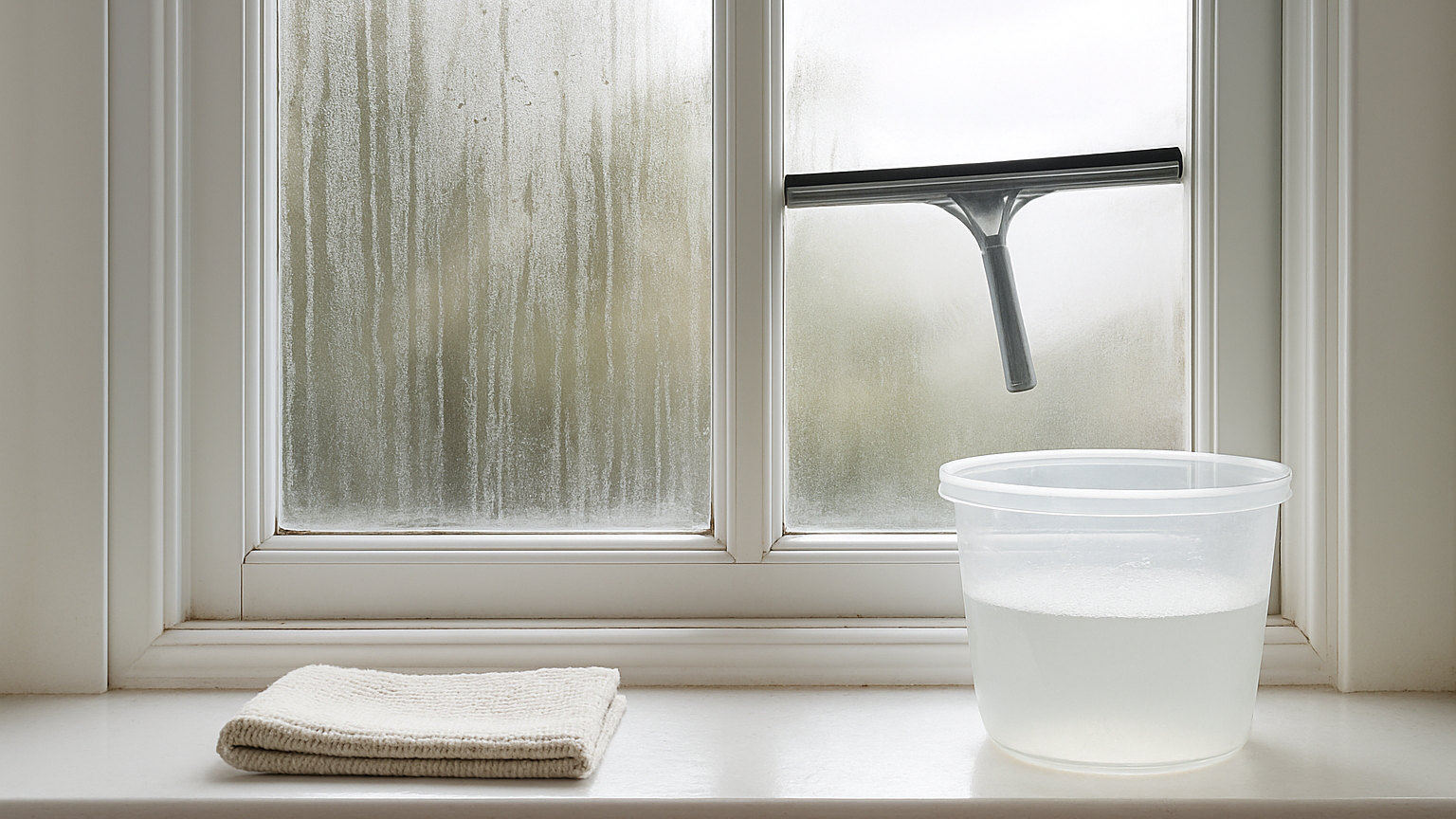
Streaks on glass are almost always residue rather than dirt. Something has been left on the surface – cleaning product, minerals from the water, fibres from the cloth – and it dries into a film that catches the light. The reliable route to streak free glass is to use very little product and to physically remove the water rather than letting it evaporate.
Why does more product make it worse?
Because glass is non-porous and has nowhere to absorb anything. Every drop of cleaner applied has to be removed again, and any excess dries on the surface. A window sprayed six times and wiped once will streak badly; the same window cleaned with a barely damp cloth and buffed dry will not.
Products that promise added shine are the worst culprits, since the shine comes from something deposited on the glass.
What is the simplest method that works?
- Dust the frame and the glass dry first, so you are not turning dust into mud.
- Wash with warm water containing a single drop of washing up liquid, applied with a cloth or a sponge.
- Remove the water with a squeegee, or dry with a clean microfibre cloth.
- Buff with a second, completely dry cloth, working in one direction.
- Do the edges and corners last with a dry cloth wrapped over a finger.
That is the whole of it, and no proprietary cleaner is needed for ordinary glass.
Which cloth should you use?
A clean, lint free microfibre cloth, and ideally two: one for drying and one kept exclusively for the final buff. The buffing cloth should never be used for anything else.
The most common hidden cause of streaking is fabric conditioner. It coats fibres with a water repellent film by design, and a cloth washed with it will smear glass every time regardless of technique. Wash cleaning cloths hot, with detergent only, and no conditioner.
Does the water matter?
In a hard water area, yes. Dissolved minerals are left behind when water evaporates and show as a fine haze or as spots. Drying the glass fully rather than letting it air dry solves most of it. For a perfect finish, a final wipe with distilled water, or with water containing a splash of white vinegar, removes what remains.
This is also why professional window cleaners use purified water with a pole system and leave the glass to dry without touching it. With no minerals in the water there is nothing left behind.
Why should you avoid direct sunlight?
Because the glass is hot and the solution evaporates before it can be removed, which is precisely the condition that creates streaks. Work on an overcast day, early in the morning, or on whichever elevation is in shade at the time. If the sun is unavoidable, work in small sections and dry each one immediately.
Does newspaper actually work?
It does, and it was standard practice for generations. The paper is absorbent, lint free and slightly abrasive, and the ink was traditionally thought to help though it probably contributes little. Modern newsprint is thinner and some inks transfer onto uPVC frames, so it is worth testing before using it everywhere.
A good microfibre cloth outperforms it and can be washed hundreds of times, which makes it the better choice for most people.
How do you find the streaks you missed?
Look at the glass from an angle rather than straight on, and from both sides where possible. A common trick is to dry the inside with horizontal strokes and the outside with vertical ones, so when you spot a streak you know immediately which side of the glass it is on. It takes no extra time and saves cleaning the wrong surface twice, which is otherwise a familiar and irritating way to spend ten minutes.
Does the temperature of the water matter?
Warm water works better than cold, because it cuts grease more effectively and evaporates a little faster once the glass has been squeegeed. Very hot water is counterproductive: it dries too quickly on the pane and in summer can stress cold glass.