Sprinkling powder on a grease stain is one of the few traditional stain remedies that genuinely works, and it works for a clear physical reason. Oil has a strong affinity for fine particles with a large surface area, so it migrates out of fabric into the powder. Unlike salt on red wine, this is not folklore.
Which powders work?
- Cornflour – very fine, widely available and effective. The best general choice.
- Talcum powder – equally fine and excellent, particularly on delicate fabric.
- Bicarbonate of soda – slightly coarser but effective, and it deodorises at the same time.
- Fuller earth – a clay used professionally for exactly this and the most effective of the group.
- Chalk – works, and traditionally used on tailoring.
- Crushed dry cat litter – coarse and effective on heavy oil spills, particularly on garage floors.
Ordinary flour works in an emergency and is less effective, since the particles are coarser and it can go sticky if it gets damp.
How long should they be left?
Longer than most people manage. Fifteen minutes on a fresh light mark, an hour for anything substantial, and overnight for a heavy oil spill on carpet or on a driveway.
The powder should be visibly discoloured when you brush it off. If it comes away white, either the stain was not greasy or it did not have long enough.
What is the correct method?
- Blot up any liquid oil first with kitchen paper.
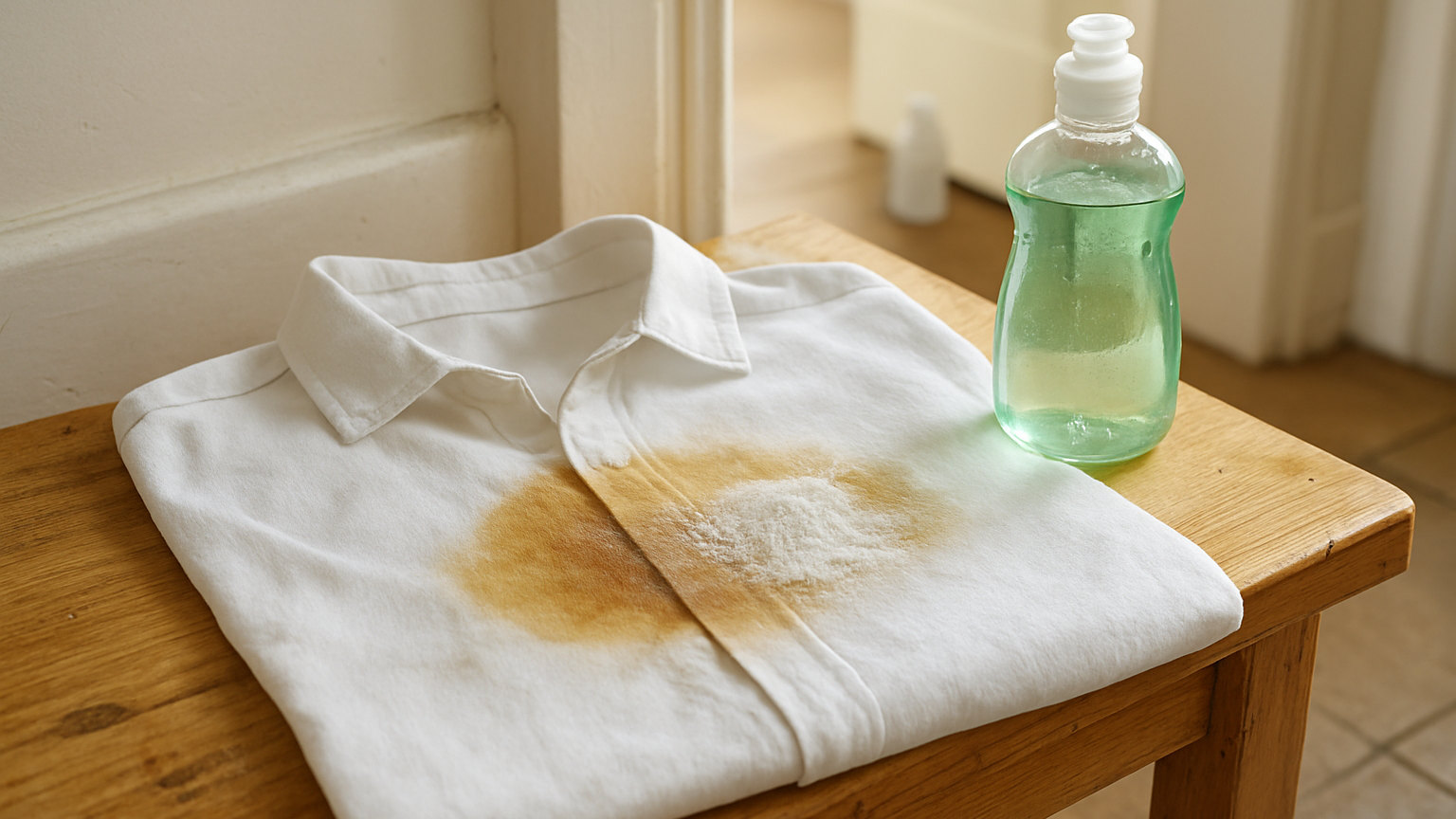
- Cover the mark generously, not sparingly. Use enough that the powder sits in a layer rather than dusting the surface.
- Press it gently into the fabric so it is in contact with the fibres.
- Leave it for the appropriate time.
- Brush or vacuum it off.
- Repeat if the powder discoloured heavily.
- Follow with washing up liquid and warm water for what remains.
Do they remove the stain completely?
Rarely on their own, and that is the realistic expectation. Powder removes a proportion of the oil, often a large proportion on a fresh mark, and makes the detergent stage far more likely to finish the job. It is a first step rather than a treatment.
On old oxidised grease it does considerably less, since the oil has bonded to the fibre rather than remaining mobile.
Why does the same idea fail on other stains?
Because the mechanism is specific to oil. Water based stains such as wine, tea and fruit juice do not migrate into powder in the same way; the powder simply absorbs the surface liquid and leaves the pigment. That is why salt on red wine achieves so little and cornflour on cooking oil achieves a great deal.
Where are they most useful?
On surfaces that cannot be rinsed. Carpet, upholstery, mattresses, car seats and unsealed stone all benefit enormously, because a dry treatment introduces no moisture and carries no risk of a water ring or wicking.
On a garage floor or a driveway, cat litter left overnight and swept up removes most of an oil spill before any degreaser is needed.
Are there any risks?
Very few. Powder left in carpet attracts moisture and can leave a residue, so vacuum thoroughly rather than leaving traces. On dark fabric, brush carefully and check that nothing remains in the weave. Talc on very delicate fabric should be brushed rather than rubbed.
What about proprietary dry cleaning powders?
These are usually a clay or starch base with a solvent added, and they work on the same principle with the addition of a dissolving agent. They are effective and considerably more expensive than cornflour, which is worth knowing before buying one for a single stain.
Do they work on old stains?
Far less well, and that is the main limitation. Powder relies on the oil still being mobile enough to migrate, and oxidised grease that has bonded to the fibre will not move. On anything more than a few days old the powder stage is worth doing and should not be expected to achieve much, with the detergent and solvent stages doing the real work.