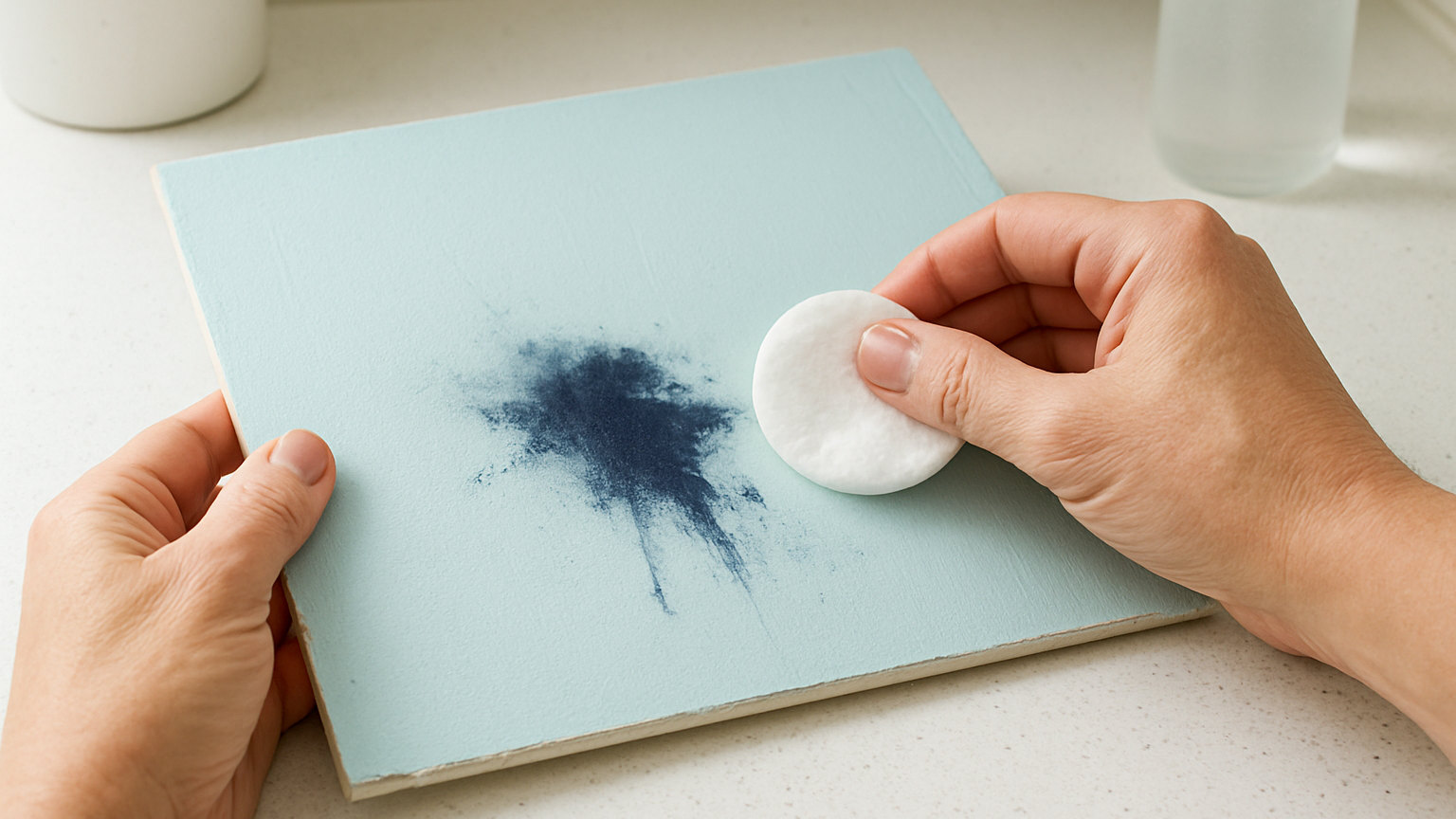
Ink on a wall is one of the few stains where the honest first answer is often to repaint the patch rather than remove the mark. Matt emulsion has a porous, unprotected surface, and anything that dissolves ink will usually lift some paint with it. Knowing that at the start saves a great deal of effort producing a worse result.
What kind of paint is on the wall?
It determines everything.
- Matt emulsion – porous, easily marked and easily damaged by cleaning. The most common and the most difficult.
- Vinyl silk and soft sheen – a slight film makes them noticeably more tolerant.
- Washable or scrubbable emulsion – formulated for exactly this and the most forgiving.
- Eggshell, satinwood and gloss – durable and usually cleanable.
If you do not know, assume matt and start with the gentlest option.
What is the order to try things in?
- A dry cloth or a clean pencil eraser, which lifts some pen marks with no risk at all.
- A barely damp cloth with a drop of washing up liquid, dabbed rather than rubbed.
- A cotton bud with surgical spirit, applied lightly to the mark only, tested in a hidden spot first.
- A melamine sponge, used damp with almost no pressure, accepting that it may dull the surface.
- Touching up with matching paint.
Move down the list only when the previous step has failed, and stop as soon as the paint starts to look affected.
Why does rubbing make it worse?
Because matt emulsion burnishes. Pressure and friction compress and polish the surface, producing a shiny patch that catches the light and is usually more visible than the ink was. It cannot be undone except by repainting.
Dab, do not rub, and use a cotton bud rather than a cloth so the treated area stays as small as possible.
What about melamine sponges?
They are effective and they work by fine abrasion, which means they remove the mark and a thin layer of paint together. On washable, silk or eggshell finishes they often work cleanly. On matt emulsion they frequently leave a dull patch.
If you use one, use it barely damp, with no pressure, and expect to touch up afterwards.
Why is touching up often better?
Because a small dab of the original paint applied with a fine brush and feathered at the edges takes two minutes and gives a perfect result, while ten minutes of cleaning gives a burnished or dulled area. On a wall in a child bedroom this is almost always the right decision.
It depends on having the paint, which is the argument for keeping a labelled pot from every room with the date and the finish on the lid.
What if you have no matching paint?
Emulsion rarely matches across batches and every wall fades slightly with light, so a patch of nominally identical paint will often show. Repainting the wall from corner to corner is the only way to avoid a visible patch, which is a larger job and sometimes the right one.
A bookcase, a picture or a piece of furniture in front of the mark is a legitimate solution.
What about wallpaper?
Vinyl and washable wallpapers can take a damp cloth and a little detergent, and sometimes a cotton bud with surgical spirit, tested in an offcut or a hidden area. Paper wallpaper cannot take moisture at all, and ink on it is generally permanent.
Keeping a roll of offcut from any papered room is worth doing for exactly this reason, since a patch can be cut in.
How do you prevent it?
Washable emulsion in hallways, stairways and children bedrooms, which is considerably more durable and worth the small extra cost. Keep permanent markers out of reach, and provide somewhere that drawing is allowed, since a large sheet of paper is cheaper than a wall.
Does the age of the mark matter?
Less than with fabric, because the ink is sitting on a non absorbent painted surface rather than working into fibres. A pen line on emulsion is about as removable after a month as after a day. What does change is the surrounding wall, which fades slightly over time, so a touch up on an older wall is more likely to show than one done soon after painting.