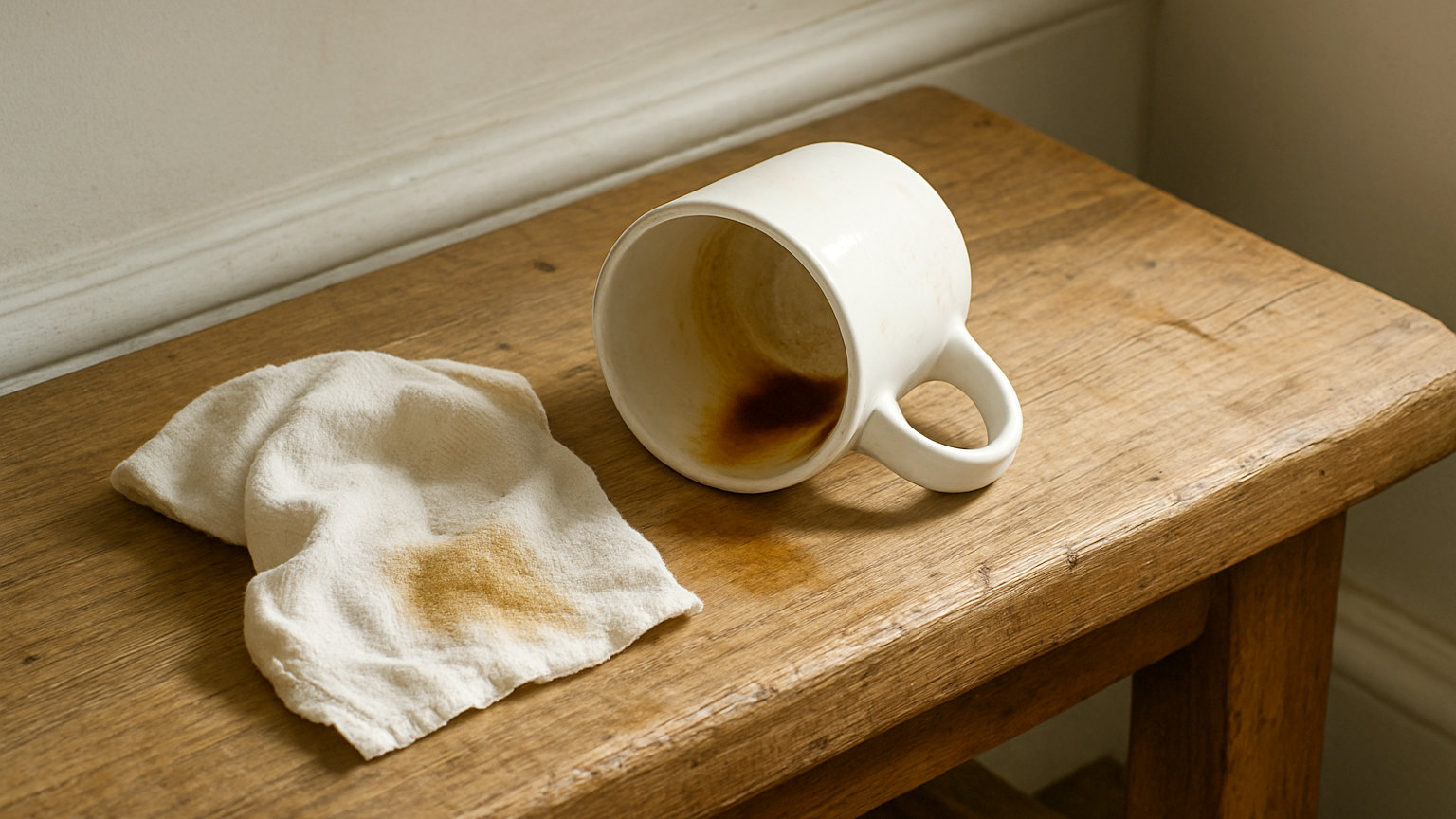
The brown film that builds inside a tea or coffee mug is tannin bonded to the surface of the glaze. Glaze looks smooth and is microscopically rough, and the tannins settle into that texture where a cloth and washing up liquid cannot reach them. Detergent lifts grease and does almost nothing to a tannin deposit.
What actually removes it?
Mild abrasion, oxidation, or both. Three household methods cover almost every case.
- Bicarbonate of soda – a paste made with a little water, rubbed round the inside with a cloth or a finger. Cheap, quick and safe on most glazes.
- Oxygen bleach – a teaspoon dissolved in hot water, filled to the top and left for an hour. Removes the deposit chemically with no scrubbing at all.
- A denture cleaning tablet – the same active ingredient in tablet form, dropped into a mug of hot water and left. Effective and slightly more expensive per use.
For a badly stained mug, soak first and then scrub, which needs far less effort than scrubbing alone.
Why does the dishwasher not clear it?
Dishwasher detergent is strongly alkaline and good at grease and starch, and it is not formulated to oxidise tannins. Mugs that come out of a dishwasher looking clean often still have a brown ring visible in daylight, particularly in white china.
A mug that stays stained despite daily dishwasher use needs a soak rather than more cycles.
What about salt and lemon?
It works, and it is essentially a mild abrasive with a weak acid. Half a lemon dipped in salt and rubbed round the inside lifts light staining and leaves the mug smelling pleasant. It is less effective than bicarbonate on a heavy deposit and less effective than an oxygen soak on anything set in.
What should you avoid?
Anything aggressive enough to scratch the glaze. A scratched glaze holds tannin far more readily, so a mug scoured with wire wool or a harsh scourer will stain faster from then on.
- Wire wool and metal scourers, which scratch permanently.
- Scouring powders, which are harsher than they look on fine china.
- Chlorine bleach, which works and leaves a taste that is difficult to rinse away.
- Melamine sponges on hand painted or gilded china, which will remove the decoration.
What about travel mugs and flasks?
These stain worse than china because the interior is usually stainless steel with a sealed lid, and they are rarely dried out. An oxygen bleach or denture tablet soak is the right approach, since a bottle brush cannot reach the base and the threads.
Pay attention to the lid, which has seals and a drinking spout where residue collects and where the smell usually originates. Take the seal out if it comes out and wash it separately.
What about teapots?
Ceramic teapots take the same treatment. Fill with hot water and oxygen bleach, leave an hour, and rinse thoroughly.
Cast iron and seasoned clay teapots are a different matter, and many enthusiasts deliberately leave the patina in place. Never use detergent or bleach inside an unglazed clay pot, which will absorb it and affect the taste permanently. Hot water and a soft brush only.
Does it affect the taste?
Yes. A heavy tannin deposit is bitter and it transfers into whatever is brewed in the mug afterwards. People who describe a mug as making tea taste wrong are usually tasting the last hundred cups.
How do you keep them clear?
Rinse mugs with hot water as soon as they are empty rather than leaving them on a desk all day. A mug rinsed immediately builds almost no deposit. Give the tea mugs an oxygen soak every month or two, which takes an hour of doing nothing and keeps them presentable indefinitely.
Does the water hardness make a difference?
It does. In a hard water area the limescale deposit and the tannin deposit build together, forming a film that is harder to shift than either alone. A soak that combines descaling and oxidising works best there: citric acid or white vinegar first to clear the scale, rinse, then oxygen bleach for the tannin.