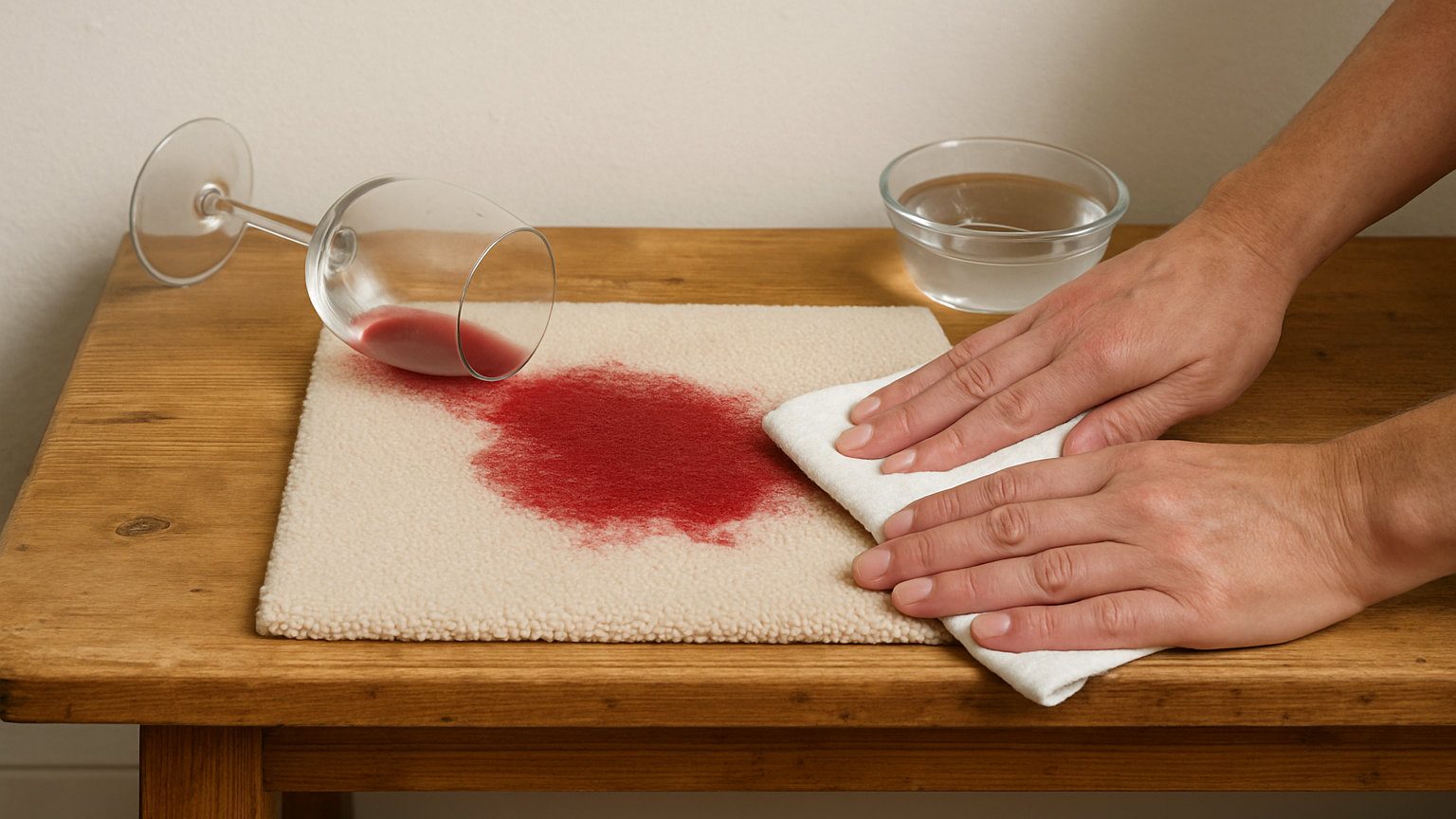
Red wine on carpet is the stain people panic about most, and the panic causes most of the damage. Two instincts are both wrong: rubbing at the mark, which drives the pigment into the backing and damages the pile, and pouring liquid onto it, which spreads a small spill into a large one.
What should you do in the first minute?
- Blot immediately with a clean white cloth or a thick wad of kitchen paper.
- Press straight down and lift. Do not wipe, drag or rub.
- Keep moving to a dry section of cloth so you are absorbing rather than redistributing.
- Work from the outside of the spill inwards, which stops it spreading.
- Stand on the cloth if the spill is large, since body weight extracts far more than hand pressure.
- Keep going until very little further transfers onto the cloth.
This stage removes most of the wine. Everything afterwards is dealing with what soaked in below the surface.
What do you use next?
Cold water with a small amount of washing up liquid, applied to a cloth rather than poured onto the carpet. Dab the area, blot with a dry cloth, and repeat. The detergent lifts the pigment and the blotting takes it away.
For a stubborn mark on a colourfast synthetic carpet, a solution of one part hydrogen peroxide to two parts water works well, tested first in a hidden area. It should not be used on wool.
Finish by blotting with a cloth dampened in clean water to remove the detergent, or the residue will attract dirt and the area will go dark within weeks.
Why does extraction matter so much?
Because the wine that soaked into the backing and the underlay is still there. As the carpet dries, that residue travels back up the fibres and the stain reappears as a faint outline a day or two later. That is wicking, and it is the usual reason people conclude a treatment failed.
Press a dry towel down over the damp area and weight it with something heavy for several hours. That draws the moisture upwards into the towel rather than letting it evaporate through the pile. Then dry the area quickly with a fan or an open window.
Does soda water help?
Marginally, and not because of the bubbles. Any cold liquid dilutes the wine and makes it easier to blot out, and soda water is no better at that than tap water. The carbonation makes no difference to the chemistry.
If soda water is what is to hand, use it. Do not go looking for it while the stain sets.
What about wool carpet?
Wool needs more care and is more likely to be permanently damaged by the wrong product. Avoid hydrogen peroxide, oxygen bleach and anything strongly alkaline, all of which affect the dye or the fibre.
Use cold water, a wool safe carpet cleaner and minimal moisture. Wool also absorbs more readily than synthetic fibre, so the blotting stage matters more and needs to be more thorough.
What should you never do?
- Rub, which spreads the stain and permanently damages the pile.
- Use hot water, which darkens the tannins and sets the mark.
- Use a steam cleaner before the stain has gone, for the same reason.
- Pour anything directly onto the carpet.
- Use a coloured cloth, which can transfer its own dye into damp carpet.
How do you know when to stop?
When the cloth stops picking up colour. Continuing to work a treated area beyond that point achieves nothing and risks damaging the pile. Let it dry fully and assess it then, since a damp patch always looks worse than it will.
When should you call someone in?
For a large spill, for an expensive or wool carpet, and for any stain that has wicked back twice. Professional hot water extraction removes the water it puts in, which is the one thing a cloth and a bowl cannot do properly.