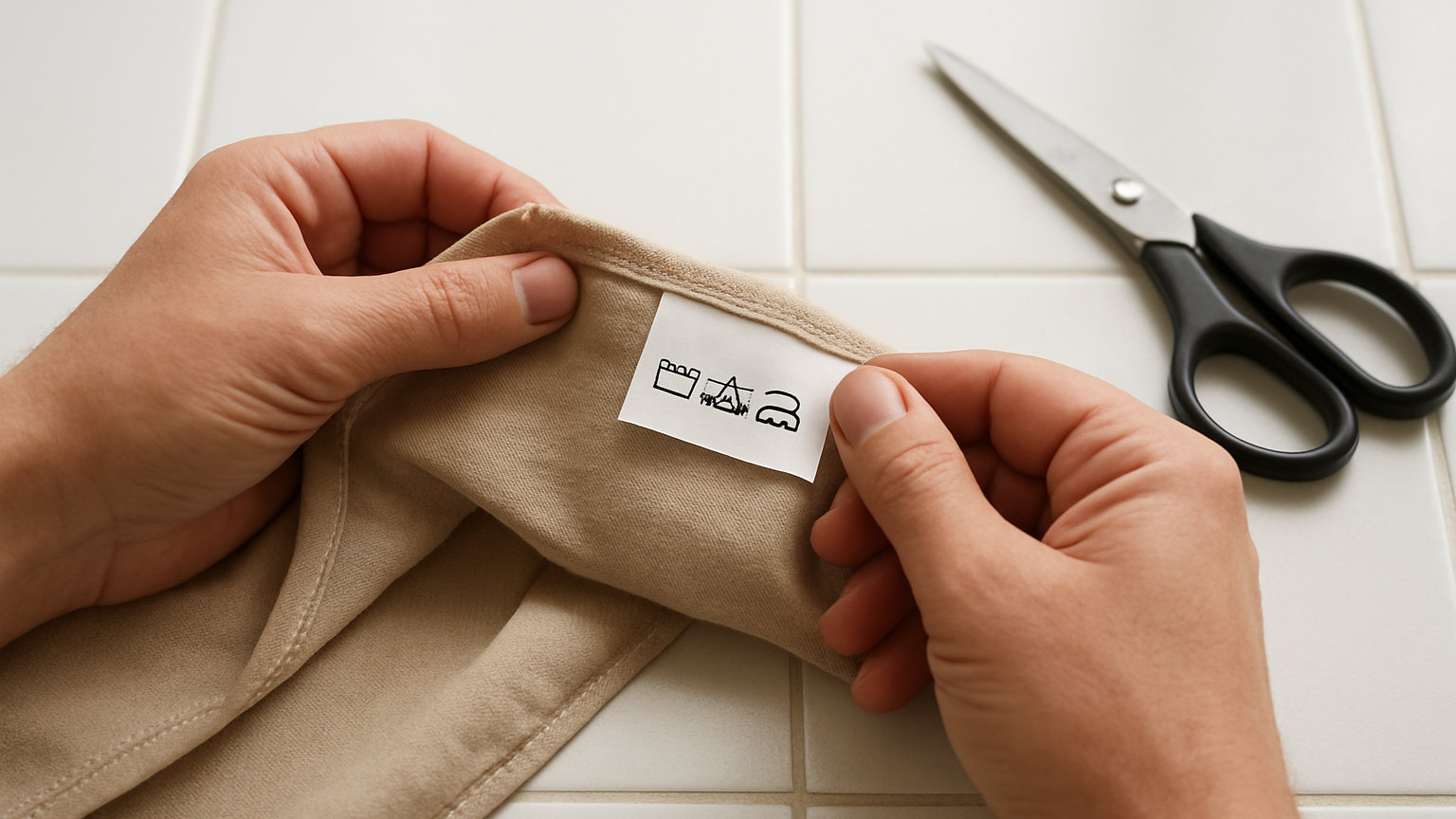
Care labels are frequently uncomfortable, particularly stiff woven ones at the back of a neck, and cutting them out is a reasonable thing to do. The complications are that some labels are structural to the seam, and that the information on them is genuinely useful and gone once the tag is.
How should a label be removed safely?
Look at how it is attached first. Most labels are caught in a seam at one edge and hang free, which makes them easy to trim. Some are stitched on all four sides to the fabric itself, and a few are part of the seam construction.
- Turn the garment inside out and find where the label is secured.
- If it hangs from a seam, cut across the label itself, leaving three or four millimetres of tag above the stitching.
- Do not cut into the stitch line, which will release the seam.
- If the label is stitched on all sides, unpick it carefully with a seam ripper rather than cutting.
- Check the seam afterwards and secure it with a few stitches if anything has loosened.
Cutting flush to the seam is the common mistake, and it is how a neckline comes apart in the wash a month later.
What should you do with the information first?
Photograph it. A picture of the care symbols and the fibre content takes two seconds and means you can still look it up. Keeping those photographs in one album on a phone is more practical than any written record.
The alternative, and the reason people guess at how to wash things, is that the tag went in the bin with the instruction on it.
Are there alternatives to cutting?
Several. Unpicking the stitching at one end only allows the label to be folded flat and stitched down against the garment, which removes the scratchy edge without losing anything. A small piece of soft fabric stitched over the tag achieves the same.
Some people simply turn the garment inside out to check the label on the first wash and then cut it, which keeps the information available for as long as it is needed.
When should you leave the label in?
- On anything you might resell, since a missing label reduces the value and buyers ask.
- On anything under warranty or likely to be returned.
- On children clothing where flammability information is printed on the tag.
- On anything with unusual or specific care requirements you are unlikely to remember.
- On workwear or protective clothing, where the label may carry safety certification.
What about printed labels?
Increasingly, care information is printed directly onto the fabric inside the neckline instead of being sewn in. These solve the itching problem and create a different one, since the print wears off with washing and is often illegible within a year.
Photograph these when the garment is new, because there is nothing to cut out and nothing to refer back to once it has faded.
Does the label itself cause irritation?
The stiffness and the cut edges do, more than the material. Woven polyester labels have hard selvedge edges that rub against skin, and the problem is worst at the nape of the neck where a collar sits. Printed satin labels and tagless printing were both developed in response to exactly this complaint.
For anyone with genuinely sensitive skin, removing labels from anything worn against the body is a sensible adjustment rather than a fussy one.
Is it worth doing for the whole wardrobe?
Probably not in one session. Do it as items become irritating, photograph as you go, and leave alone anything that has never bothered you. The label is only a problem when you can feel it, and the information is worth keeping for everything else.
What about labels in bedding and towels?
These are rarely against skin in the same way and are worth leaving in, since bedding and towels are the items most likely to be washed at a specific temperature and most likely to be replaced piecemeal over years. A label in a duvet cover seam bothers nobody and saves guessing whether a set can take 60 degrees.