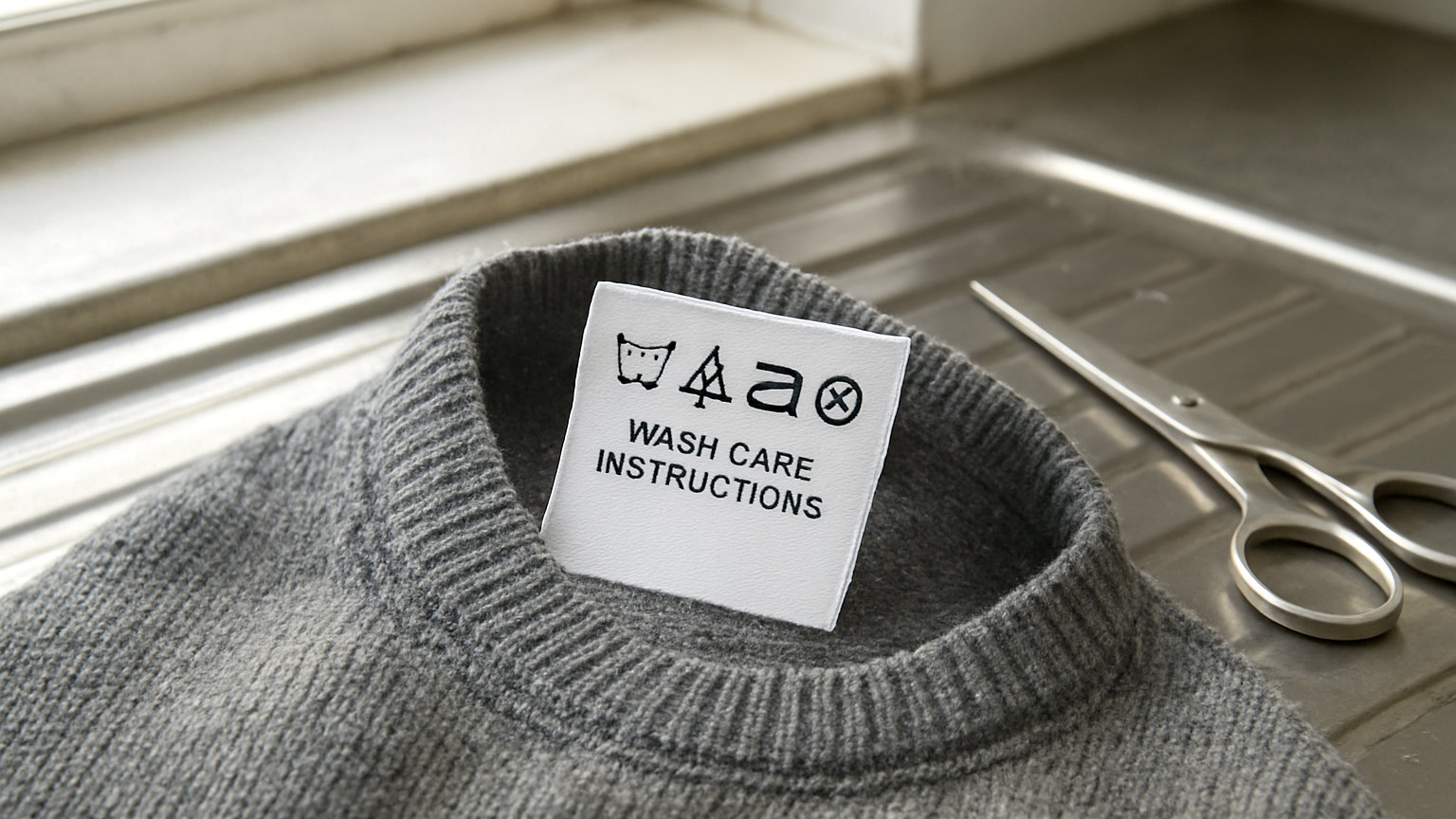
Next to the care symbols there is usually a second label listing what the garment is made from, in percentages. It is a legal requirement in the UK and the EU, and it often tells you more about how to treat the item than the symbols do, because it explains why the symbols say what they say.
How is it written?
Fibres are listed by percentage of the total weight, largest first. A label reading 95 per cent cotton, 5 per cent elastane means exactly that. Where a garment has separate components, such as a shell and a lining, each is usually listed separately.
Trims, decoration and small components are often excluded, which is worth knowing, because a small piece of a different fibre can dictate how the whole garment must be treated.
Why does a small percentage of elastane matter so much?
Because elastane degrades at temperatures well below what cotton or polyester tolerate, and once it has gone the garment loses its shape permanently. Five per cent elastane in a pair of jeans is what makes them fit, and a few hot washes or tumble dry cycles will take it out.
Any percentage of elastane, however small, means wash cool and do not tumble dry, regardless of what the rest of the composition would allow.
What do the main fibres require?
- Cotton – tolerates heat and agitation, shrinks on first wash unless pre-shrunk, creases readily.
- Linen – strong and washable, creases severely, softens with use.
- Wool – felts with heat, moisture and agitation together. Cool, gentle, dried flat.
- Silk – damaged by alkaline detergent and heat, marked by water droplets.
- Polyester – robust, resists creasing, holds odour, melts at moderate heat.
- Nylon – strong, low melting point, prone to static.
- Viscose – loses significant strength when wet, creases badly, shrinks.
- Acrylic – warm and lightweight, pills heavily, melts at low temperatures.
- Acetate – melts very easily and water spots.
Why do blends behave unpredictably?
Because the two fibres shrink and respond to heat at different rates. A cotton and polyester blend shrinks less than pure cotton, since the polyester is dimensionally stable, but it also pills more, because the polyester holds the pills on the surface rather than letting them break away.
A wool and acrylic blend felts less than pure wool and bobbles considerably more. A cotton and viscose blend can look like cotton and behave like viscose when wet, which surprises people.
The general rule is to treat a blend according to its most sensitive component.
What does it tell you about how a garment will wear?
A great deal. Long staple cotton and worsted wool pill least. Loosely spun and short fibre yarns pill most. Acrylic is warm and cheap and will bobble within weeks. Viscose drapes beautifully and will not survive rough treatment. Polyester will outlast everything and will hold odour while doing it.
Reading the composition before buying is a better guide to how long something will last than the price is.
What about fabric names that are not fibres?
Terms such as denim, jersey, twill, fleece, satin and crepe describe the weave or knit structure rather than the fibre. Denim can be cotton or a cotton and elastane blend. Satin can be silk or polyester. Fleece is almost always polyester. The name tells you about the fabric construction; the percentages tell you what it is made from.
Is the label ever wrong?
Occasionally, particularly on unbranded and imported clothing, where compositions are sometimes approximate. If a garment behaves very differently from what the label suggests, trust the behaviour. A jumper that felts was wool whatever the label said.
What should you do with the information?
Use it to decide when the symbols are ambiguous or missing, and to override a permission you suspect is unwise. A label may permit tumble drying a cotton and elastane t-shirt; the composition tells you not to. That combination of symbol and percentage is where the useful judgement sits.