A dehumidifier is the most effective and least discussed answer to indoor laundry drying. It removes moisture from the air continuously, which keeps the air around the clothes able to absorb more, and it collects that water in a tank rather than leaving it to condense on the walls. For anyone drying indoors regularly it usually pays for itself.
How does it speed up drying?
Evaporation stops when the air immediately around wet fabric becomes saturated. In a closed room with no ventilation, that happens quickly and drying stalls. A dehumidifier pulls moisture out of the air continuously and circulates it, so the air next to the clothes stays dry and evaporation keeps going.
The fan is doing as much work as the dehumidification, which is why models with a dedicated laundry mode run the fan harder rather than simply removing more water.
How does the cost compare with a tumble dryer?
Favourably, in most cases. A domestic dehumidifier draws far less power than a tumble dryer heating element, and it runs for a few hours rather than the equivalent of a full heated cycle. For a household drying several loads a week, the running cost difference is meaningful over a winter.
It is slower than a dryer, so it suits overnight drying rather than a load needed in an hour. It is also gentler on clothes, since there is no heat and no tumbling.
Which type should you choose?
- Compressor models work like a fridge, cooling air to condense moisture out. They are efficient in warm rooms and less effective below about 15 degrees, which matters in an unheated utility room.
- Desiccant models use a moisture absorbing wheel and work well at low temperatures. They use slightly more electricity but produce a little warmth, which helps drying, and they are the better choice for cold spaces such as garages and conservatories.
For a heated house, a compressor model is usually the better buy. For a cold outbuilding or an unheated room, a desiccant model performs far better.
What capacity is needed?
Capacity is quoted in litres extracted per day. A 10 to 12 litre model handles laundry drying in a single room comfortably for most households, and a 20 litre model suits a larger house or one with an existing damp problem.
The tank size matters practically. A small tank on a busy drying day will need emptying more than once, so look for a continuous drain option if the unit can sit near a sink or a drain.
How should the room be set up?
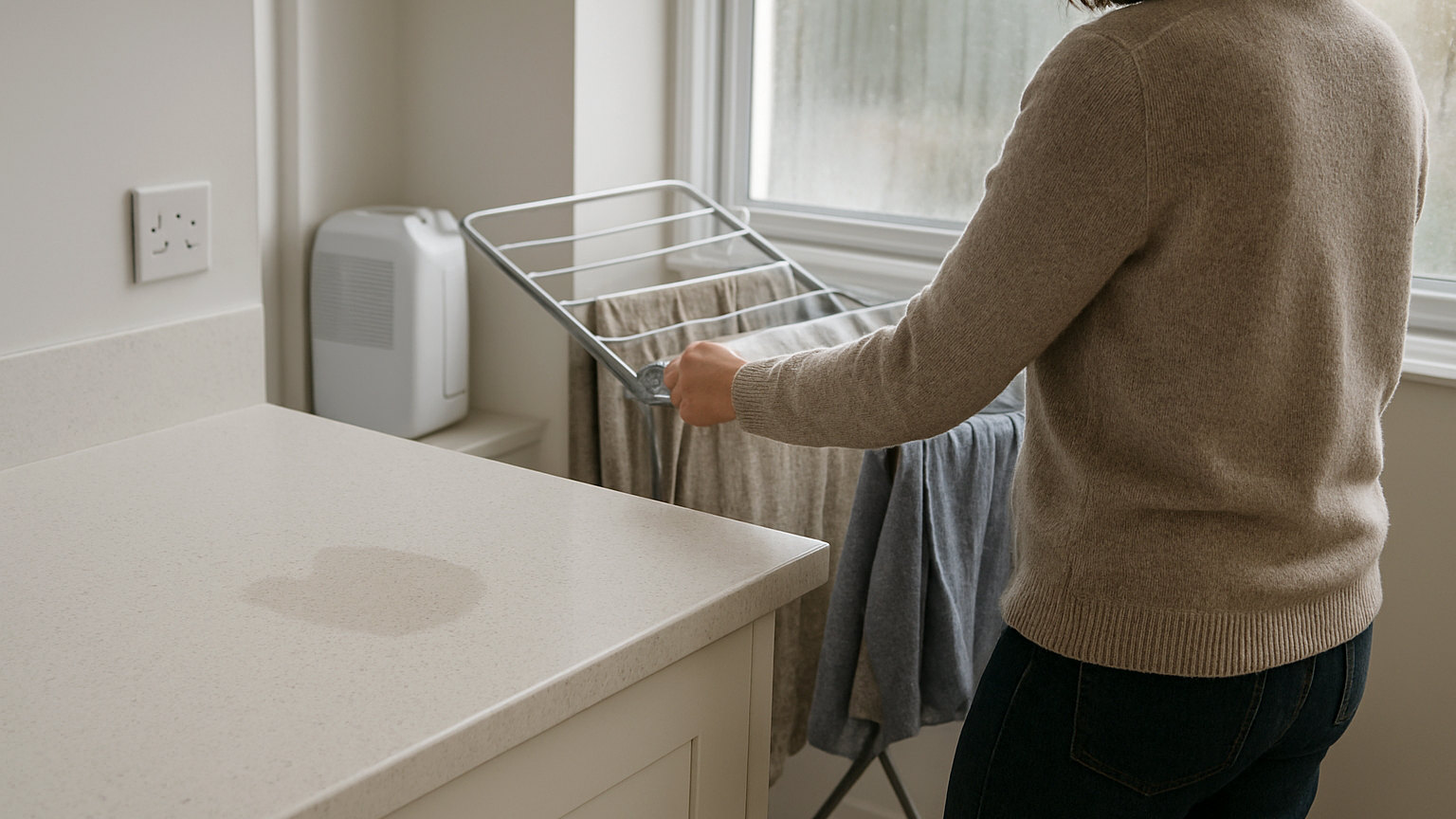
- Choose one room and keep the door shut, so the unit is working on a defined volume of air.
- Put the airer and the dehumidifier close together, with the airflow directed at the washing.
- Space the items out generously.
- Set it to laundry mode if there is one, or to continuous operation.
- Leave it running until the clothes are dry, usually four to eight hours.
Closing the window is correct here, which feels wrong but is not. The unit cannot dehumidify the outdoors, and an open window simply lets more moist air in.
What else does it do?
It addresses the underlying problem rather than just the laundry. Keeping a house below about 60 per cent relative humidity prevents condensation on windows, stops mould developing on sealant and in corners, and reduces dust mite numbers in bedding. Households that buy one for laundry often find the wider benefit is the larger one.
Is a heated airer better?
They do different jobs and work well together rather than being alternatives. A heated airer warms the clothes and speeds up evaporation; a dehumidifier removes the resulting moisture from the room and collects it in a tank. Used on its own, a heated airer dries the washing quickly and puts every litre of that water into the house, which is precisely the problem you were trying to solve in the first place.