A hallway buried under coats and shoes usually has a volume problem rather than a storage problem. Adding hooks and racks to a hall holding four coats per person and thirty pairs of shoes simply creates more places for them to accumulate. Reducing what is in circulation is the change that works.
How many should actually be in the hall?
One coat per person for the current season, plus a spare waterproof, and one or two pairs of shoes each. Everything else belongs in a bedroom, a wardrobe or storage. That is a smaller number than most halls hold, and applying it is what makes the rest of the arrangement work.
Seasonal rotation is the mechanism. Twice a year, move the out of season coats and footwear out of the hall entirely, which also gives an obvious moment to check what still fits and what should be donated.
What storage works in a narrow hall?
- A wall mounted rail with hooks rather than a freestanding coat stand, which takes floor space and falls over.
- A shallow shoe cabinet with tilting drawers, which is typically 20 to 30cm deep and fits where nothing else will.
- A bench with storage underneath, which gives somewhere to sit while removing shoes and is what makes a shoes off habit sustainable.
- Hooks at two heights, so children can hang their own coats.
- A basket for gloves, hats and scarves, which otherwise migrate throughout the house.
Where should wet coats go?
Not against a wall and not in a closed cupboard. A wet coat hung flat against plaster is a common cause of a damp patch in a hallway, and a wet coat shut in an understairs cupboard makes the whole cupboard smell within days.
A rail with air space behind it, or a few hooks on a radiator cover where the heat can reach, works far better. A drip tray or a hard floor area underneath saves the carpet.
What about wet and muddy shoes?
A boot tray by the door is the single most useful item in a hallway between October and March. It contains the water, keeps mud off the floor and gives wet footwear an obvious destination.
Let muddy shoes dry before cleaning them, exactly as with mud on carpet. Dry mud brushes off; wet mud smears into the fabric and the stitching. Stuffing wet shoes with newspaper helps them keep their shape and dry from the inside, and keeping them away from a radiator prevents leather cracking and glue failing.
How do you stop shoes taking over the floor?
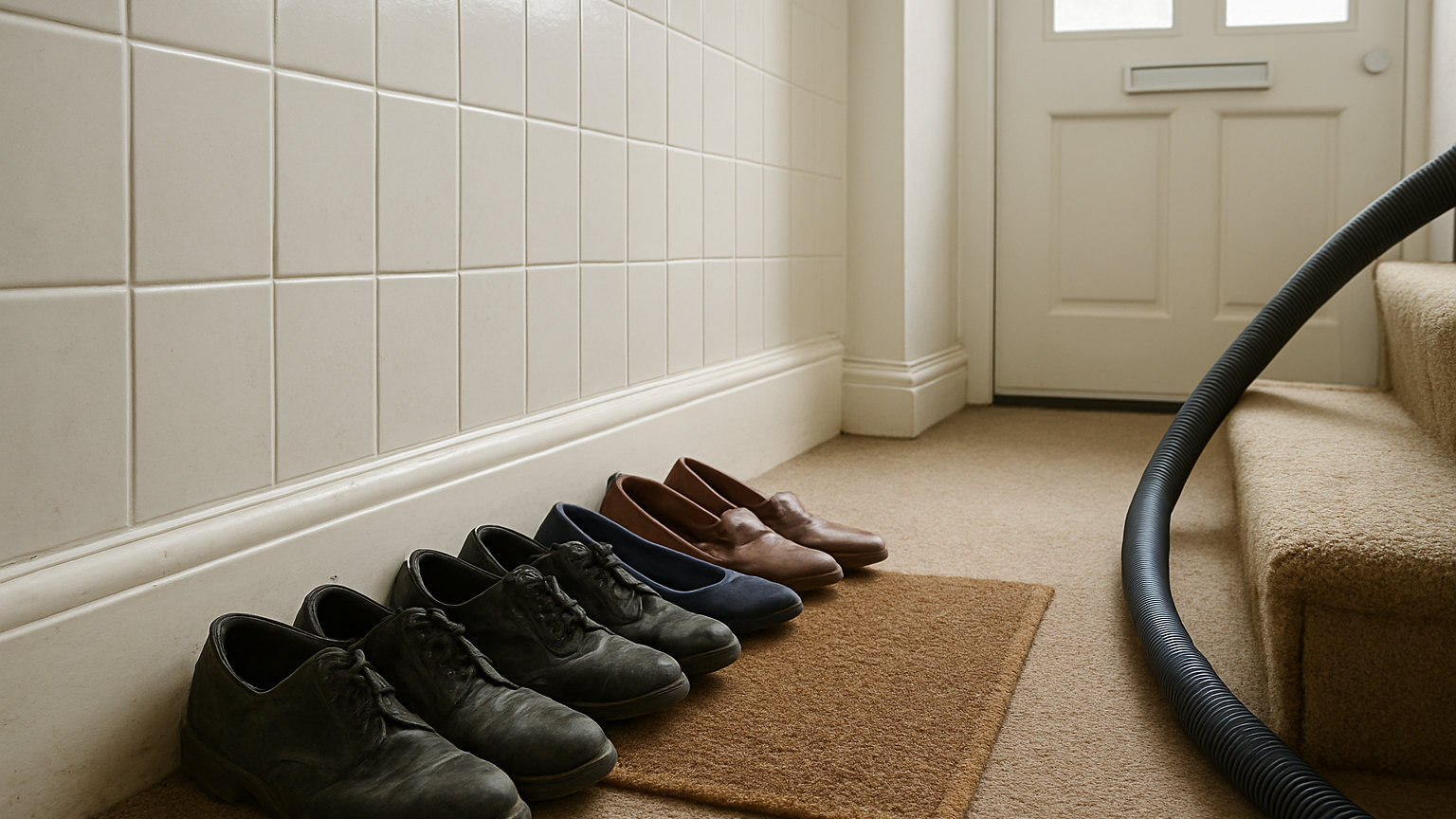
Give them a defined boundary rather than an open floor. A shoe rack, a tray or even a mat that shoes must sit on creates a visible limit, and a limit that is full is a prompt to do something. An open floor has no limit and simply absorbs more.
A one in, one out rule for the hall works well: if a pair comes down from a bedroom, a pair goes back up.
How do you keep the area clean underneath?
Choose storage that either has legs or sits flush. The worst option is a cabinet with a 5cm gap underneath, which collects dust, grit and single socks and cannot be reached. Lift or move whatever is there when you vacuum, and clean the tray or rack itself monthly, since it collects everything the shoes brought in.
Does the household need a rule?
An agreed one helps, particularly with children. Coats on hooks rather than the newel post, shoes in the tray rather than the hall, and bags off the floor are simple and enforceable. The arrangement has to make the right action easier than the wrong one, which is why a hook at the right height matters more than a reminder.
If coats consistently end up over the banister, the honest conclusion is usually that the hooks are in the wrong place rather than that the household is careless.