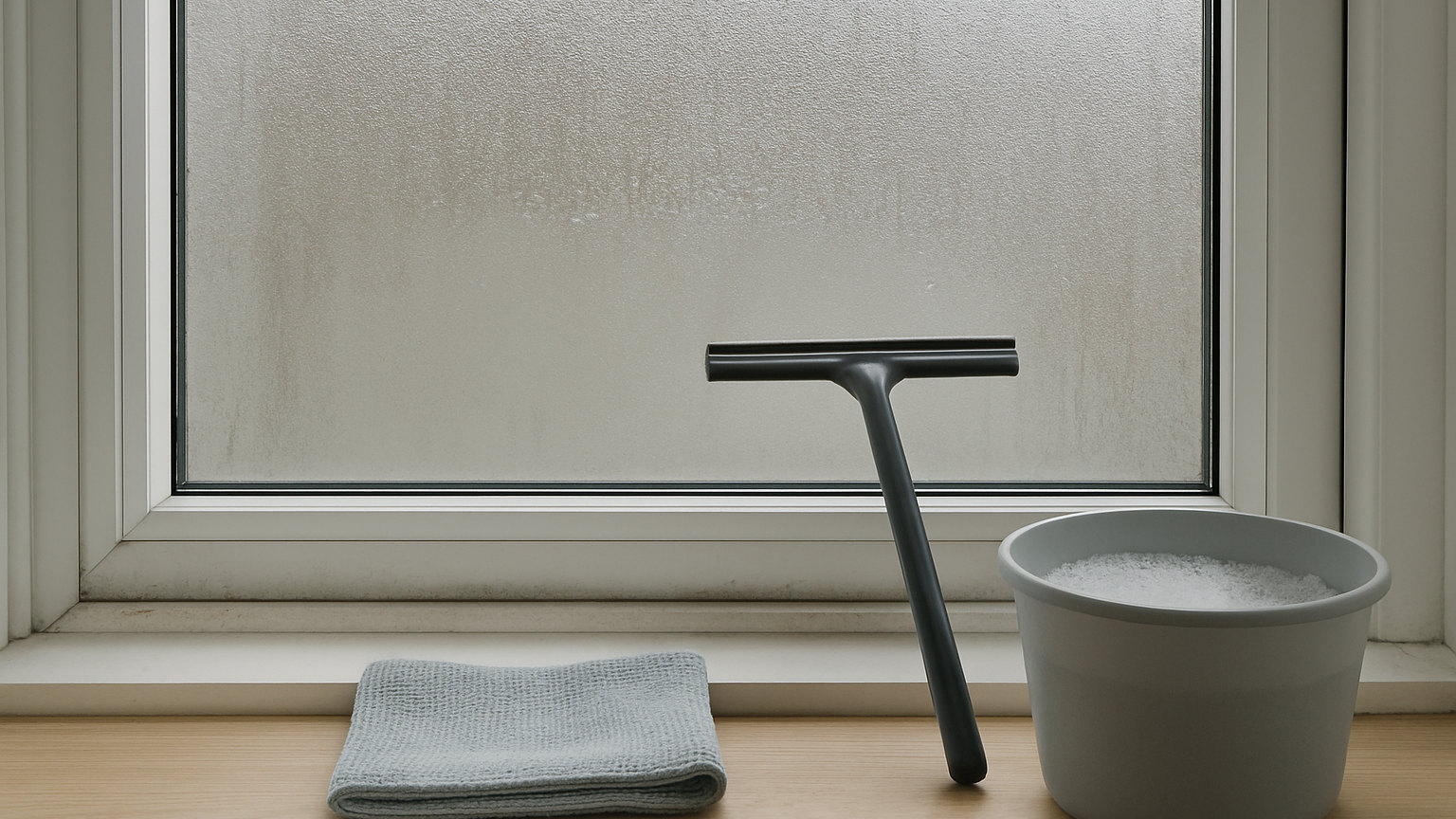
Window cleaning needs surprisingly little equipment, and the items that matter are cheap. A squeegee, an applicator, two microfibre cloths and a bucket will handle almost every window in a domestic house, and together they cost less than a few bottles of branded spray.
What is the basic kit?
- A squeegee, ideally 25 to 35cm wide for domestic windows, with a replaceable rubber blade.
- An applicator or T-bar, which is a sleeve of absorbent fabric on a handle used to wet and scrub the glass.
- Two microfibre cloths, one for detailing the edges and one kept dry for buffing.
- A bucket wide enough to take the applicator.
- Washing up liquid, of which a single drop per bucket is sufficient.
That combination is what most professionals use, minus the pole system, and it works far better than a spray bottle and kitchen towel.
What does the squeegee actually do?
It removes the water in a single sweep, which is the step that prevents streaks. Cloths absorb water but always leave a film behind; a squeegee blade in good condition takes the water off cleanly and leaves nothing.
The blade is the critical part. A nicked, dried out or aged rubber leaves lines on the glass no matter how good the technique, and blades are inexpensive and easy to replace. Store the squeegee with the blade clear of any surface so it does not develop a flat spot.
Why use an applicator rather than a cloth?
Because it holds far more water, spreads it evenly and has enough texture to loosen dirt without scratching. A cloth runs dry quickly and has to be returned to the bucket constantly, which makes the job slower and the coverage patchier.
The sleeve comes off and goes in the washing machine, again without fabric conditioner.
What about scrim?
Scrim is a loosely woven linen cloth used traditionally for buffing glass. It is highly absorbent, leaves no lint and improves with age and washing. Many professional cleaners still prefer it to microfibre for detailing edges. It is worth trying if you enjoy the job, though a good microfibre cloth gets very close for less effort.
Which extras are genuinely useful?
An extension pole for anything you cannot reach comfortably from the ground, which is far safer than a ladder. A plastic scraper or a glass safe blade for paint spots, mortar splashes and stubborn deposits, used wet and at a shallow angle. A detail brush for the corners of the frame and the drainage slots.
A window vacuum is a genuinely good tool for condensation and for interior glass in a bathroom, and it doubles as a shower screen tool. It is less useful outside, where a squeegee is quicker.
Which gadgets are not worth it?
Magnetic double sided cleaners, which sound ideal for upper floor windows but work poorly on anything other than a specific glass thickness and can drop off. Steam window cleaners, which add moisture to a job that is about removing it. And most branded sprays, which are largely water with a small amount of surfactant and a fragrance.
How should the tools be looked after?
Rinse the squeegee blade and wipe it dry after each use, and replace it when it starts leaving lines rather than persevering with it. Wash the applicator sleeve and the cloths hot, with no conditioner, and dry them fully. Empty and rinse the bucket rather than leaving dirty water in it.
A kit kept in a small bucket together, rather than scattered across a utility room, is also far more likely to get used, which matters more than any individual item in it.
What does it cost to put together?
Very little. A domestic squeegee, an applicator, a pack of microfibre cloths and a bucket come to roughly the price of three or four bottles of branded glass spray, and the kit lasts years with only the squeegee blade needing occasional replacement. It is one of the few areas of household cleaning where the proper equipment is cheaper over time than the convenient alternative.