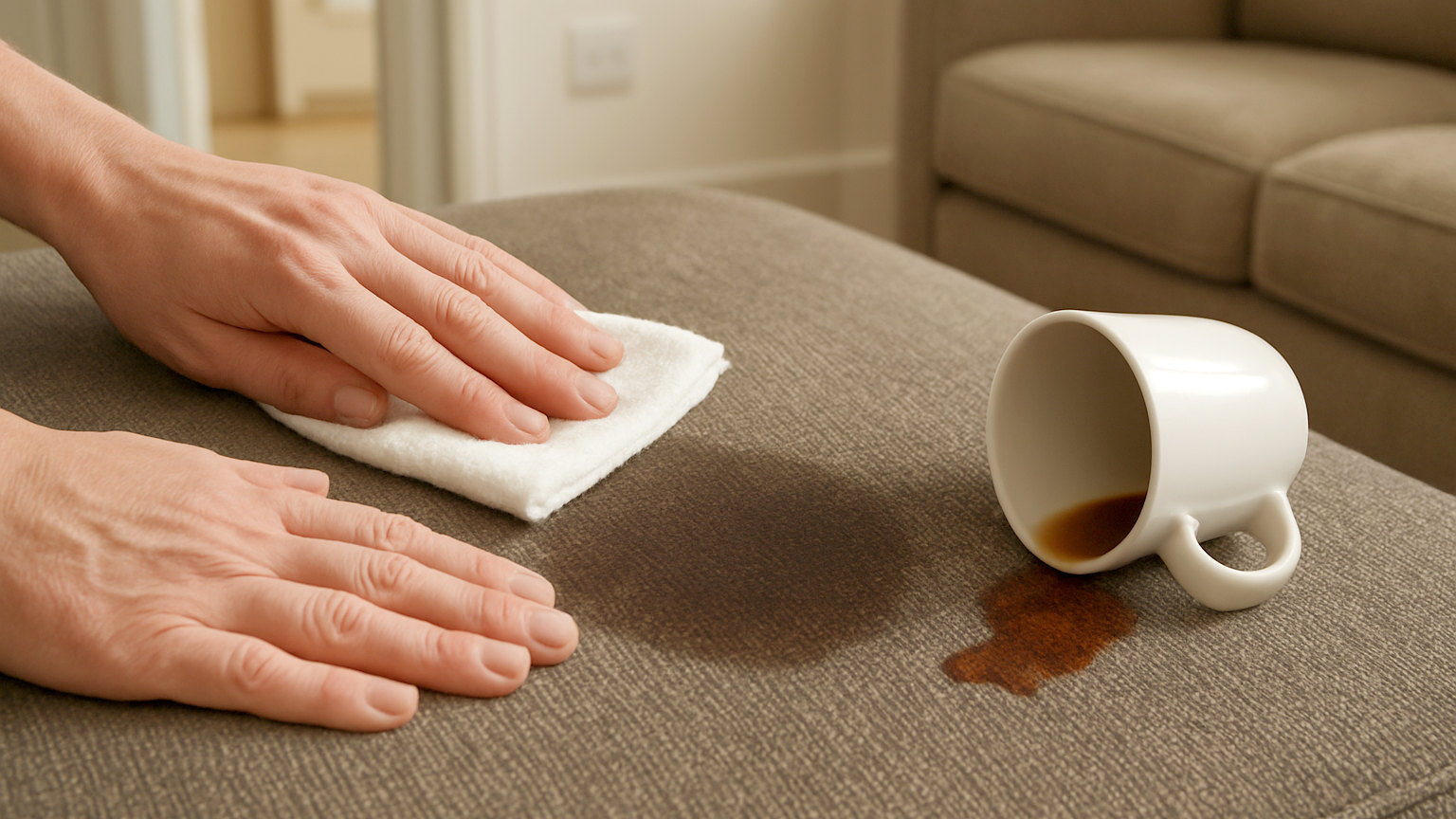
A coffee spill in a car is harder than the same spill at home, for two reasons. The fabric cannot be taken off and washed, and underneath it is a thick block of foam that absorbs liquid readily and dries very slowly. The stain is usually the easy part; the moisture and the smell that follow are the difficulty.
What should you do immediately?
- Blot with anything absorbent to hand, pressing hard rather than wiping.
- Keep pressing with fresh dry material until little further transfers.
- Push down firmly to draw liquid up out of the foam, not just off the surface.
- Work from the outside of the spill inwards.
- Get the windows open to start the drying process.
The pressing stage matters more here than anywhere else. Anything left in the foam will produce a smell within days, particularly if the coffee had milk in it.
What should you clean it with?
A solution of cool water with a drop of washing up liquid, applied to a cloth rather than to the seat. Dab the area, blot with a dry cloth, and repeat rather than saturating it.
A proprietary car upholstery cleaner is a reasonable alternative and is formulated to leave less residue. Follow with a blot using a cloth dampened in clean water, since detergent left in the fabric attracts dirt and produces a dark patch.
Why does milky coffee need an enzyme cleaner?
Because the milk protein and fat that soaked into the foam will go sour, and no surface treatment reaches them. A car interior gets hot, which accelerates it considerably, and the resulting smell is difficult to remove once established.
Apply an enzyme cleaner generously enough to cover the area the coffee reached, leave it for the time stated on the label, then blot. It continues working wherever the liquid went, which is the only practical way to deal with residue in foam.
How do you dry it properly?
This is the part that decides the outcome. Press dry towels down under weight for as long as you can. Then leave the windows open, run the fan on cold with the air directed at the seat, and park in the sun if the weather allows.
A small fan or a dehumidifier in a garage overnight works well. Damp foam in a closed car in warm weather grows mould, and that is a considerably bigger problem than a coffee mark.
What about the carpet and the footwell?
Car carpet sits on sound deadening material that holds water even more stubbornly than seat foam. Lift the mats out and wash them separately. For the fitted carpet, use the same blot and extract approach, and consider lifting an edge if a large volume has gone in.
A wet and dry vacuum is genuinely useful here and is worth borrowing for a large spill.
What about leather and vinyl seats?
Far easier. Coffee sits on the surface of coated leather and vinyl, so blot immediately and wipe with a cloth dampened in warm water, then dry. Follow with a leather conditioner on leather, since repeated cleaning dries the finish.
Check the perforations on ventilated seats, where liquid runs through to the foam beneath. Those need the same treatment as fabric.
What if a smell has already developed?
Treat it as a residue problem rather than an air problem. An enzyme cleaner applied generously and left to work is the only thing that removes the source. Follow with thorough drying and ventilation, and repeat if necessary.
Air fresheners add a second smell and change nothing. An open tub of bicarbonate of soda or activated charcoal left in the car for a few days absorbs what remains once the source has been dealt with.
What prevents it?
A cup holder that actually fits the cup, and a lidded travel mug. Most car coffee spills happen because a takeaway cup is too tall or too narrow for the holder, and that is a cheaper problem to solve than a stained seat.