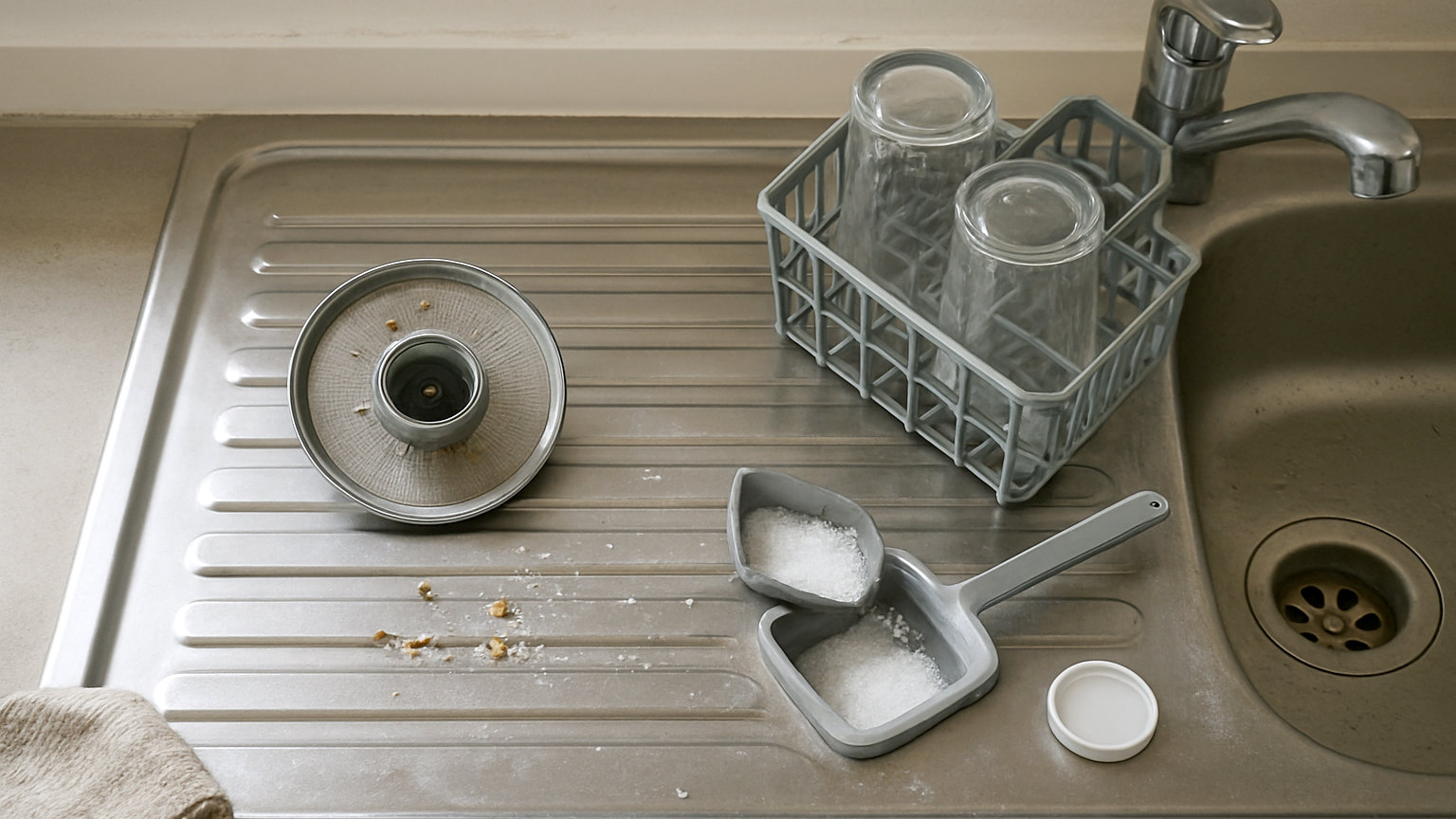
Rinse aid and dishwasher salt are frequently confused and they do unrelated jobs. Rinse aid helps water run off the load so it dries without spots. Salt regenerates the machine built in water softener so hard water does not deposit scale. Whether you need the second depends entirely on where you live.
What does rinse aid do?
It reduces the surface tension of the water so it runs off in a sheet rather than forming droplets. Droplets dry in place and leave a spot; a sheet leaves nothing behind.
The visible effects are better drying, particularly on plastics, and glasses without water spots. It is useful in any water hardness.
What does dishwasher salt do?
It regenerates the ion exchange resin in the machine built in softener. That softener removes the calcium and magnesium that cause limescale, and the resin needs recharging with salt to keep working.
It is not a cleaning agent and it does nothing to the dishes directly. Without it, in a hard water area, scale builds on the heating element, in the spray arms and on the load.
Do you need salt?
It depends on your water. Much of southern and eastern England is hard or very hard; much of Scotland, Wales, Northern Ireland and the north west is soft. Your water supplier publishes the hardness for your postcode.
In hard water, yes. In genuinely soft water, no, and adding it unnecessarily contributes to glass etching.
How do you set the hardness?
Most dishwashers have a water hardness setting, adjusted through the control panel or a dial inside the door. The manual explains the procedure, which varies by make.
Set it to match your local water. Most machines are left on the factory default, which is frequently wrong for the area, and that is the cause of a great many filming and etching complaints.
Do all in one tablets replace both?
Largely, in moderate water hardness. They contain a rinse aid component and a water softening agent, and in most areas they work perfectly well on their own.
In very hard water, separate salt is still recommended, because the softening capacity of a tablet is limited. And some machines will continue to warn about low salt regardless, which can be disabled in the settings.
If glasses are filming or drying poorly despite all in one tablets, adding separate rinse aid and salt usually resolves it.
How do you fill them?
- Salt goes into a reservoir in the base of the tub, under the bottom rack, with a screw cap. Use a funnel. Overfilling is normal and some water will overflow, which is expected.
- Run a cycle straight after filling salt, since spilled salt in the tub can mark stainless steel.
- Rinse aid goes into a small compartment beside the detergent dispenser in the door, filled to the marked level.
- Use only dishwasher salt, never table salt or cooking salt, which contain additives that damage the resin.
How often do they need topping up?
Most machines have indicator lights. Salt typically lasts a month or two in a hard water area, rinse aid a few weeks to a month depending on the dosage setting.
The rinse aid dosage is usually adjustable. Streaky glasses suggest too much; spotty ones suggest too little.
Is it worth the cost?
Yes in a hard water area, where scale on the heating element shortens the life of the machine and costs electricity. Rinse aid is worth it almost anywhere for the drying alone, particularly on plastic items that otherwise come out wet.
Are there alternatives to rinse aid?
White vinegar is sometimes suggested in the rinse aid compartment and most manufacturers advise against it, since prolonged acid contact can affect the dispenser seals. It works in the short term and is not worth the risk given how cheap rinse aid is. Opening the door at the end of a cycle to let steam escape does more for drying than any substitute.