At the bottom of a dishwasher tub, under the lower rack, is a filter assembly. It catches the food debris washed off the dishes so it is not sprayed back over the load. It fills up, and a great many dishwashers have never had it removed.
Where is it and how does it come out?
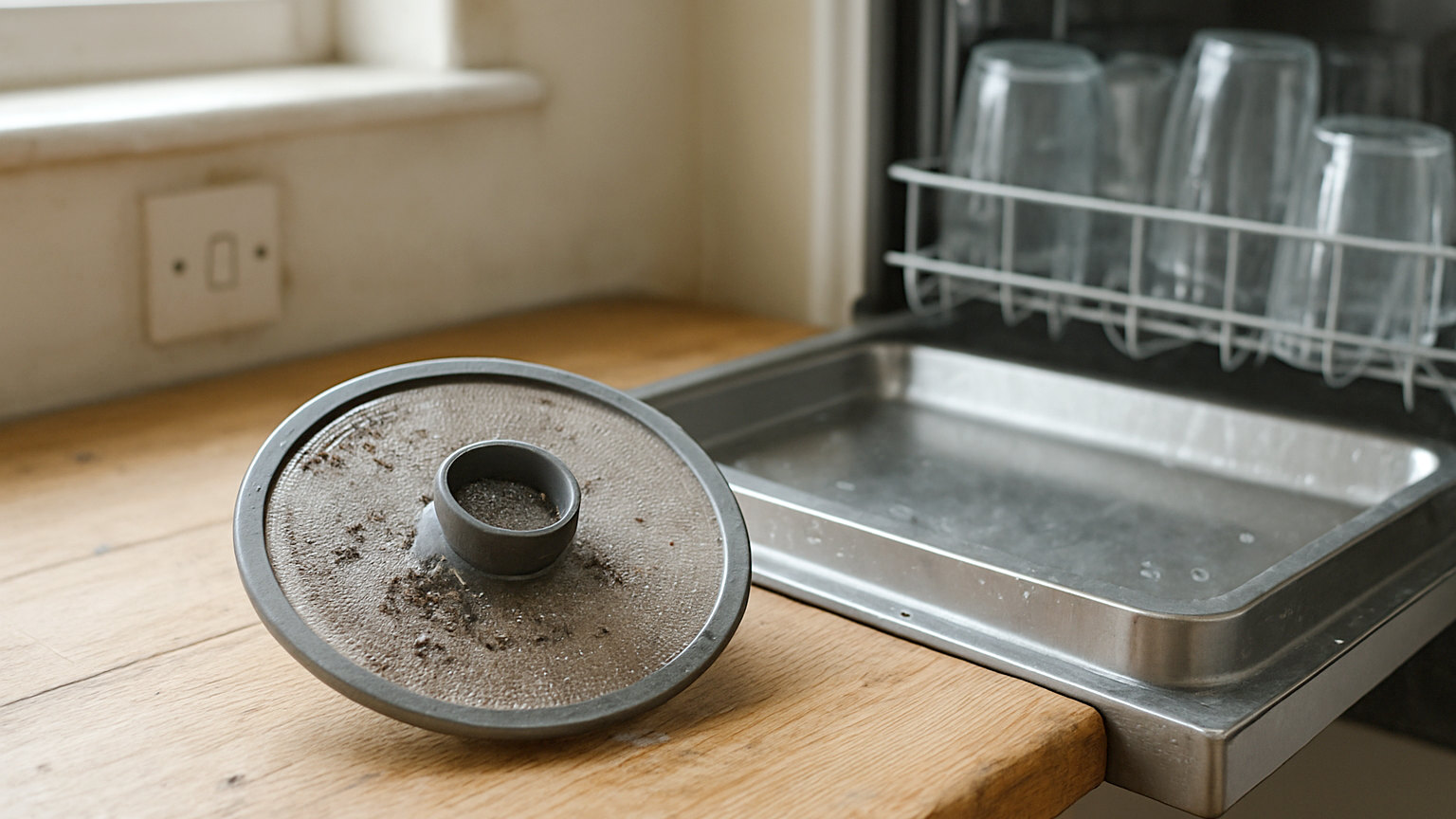
Pull the bottom rack right out and look at the base of the tub, usually towards the back centre. You will see a cylindrical section with a mesh screen around or beneath it.
Most twist anticlockwise a quarter turn and lift straight out. Underneath there is usually a flat mesh screen that also lifts out. Some machines have a third coarse filter.
Check the manual if it does not turn easily rather than forcing it.
What is the method?
- Twist and lift out the cylindrical filter.
- Lift out the flat mesh screen beneath it.
- Tip any solid debris into the bin, not the sink.
- Rinse both parts under a hot tap.
- Scrub with a washing up brush or an old toothbrush, and a little washing up liquid.
- Wipe out the sump where the filter sits, which collects sludge.
- Refit, making sure the filter is locked in place rather than just sitting there.
Why does it matter if the filter is locked?
Because a filter that is not seated properly lets food debris reach the pump, and it can also let water bypass the filtration entirely. Some machines will not run correctly with it loose.
Turn it clockwise until it stops and feels secure. There is usually an arrow or a lock symbol showing the correct position.
How often?
Weekly for a machine used daily, fortnightly for lighter use, and immediately if dishes are coming out gritty or the machine smells.
Households that scrape plates properly before loading get away with less frequent cleaning. Those who put plates in with visible food on them need it weekly without fail.
What happens if it is never cleaned?
- Dishes come out gritty, because dirty water is recirculating.
- The machine smells, because debris is decomposing in there between cycles.
- Drainage slows and eventually stops.
- The pump can be damaged by debris that gets past a badly blocked filter.
- Glasses come out cloudy with a film of redeposited soil.
What will you find in there?
Food particles, grease, labels from jars, seeds, rice, bits of paper, and occasionally something sharp. Broken glass and small bones are both common, so tip the contents out rather than reaching in with fingers.
Check the sump underneath as well, which is where the heaviest material settles.
Do all dishwashers have a removable filter?
Most modern ones do. Some older and some higher end machines have a hard food disposer, essentially a grinder, which handles the debris automatically. Those are noticeably louder in operation and need much less attention, though they still have a coarse screen worth checking.
If you cannot find a removable filter, check the manual before assuming there is none.
What else should be checked at the same time?
The spray arms, which are usually just above the filter and unclip easily, and the door seal. All three together take about ten minutes and cover the three most common causes of poor performance.
Should it be washed in the dishwasher?
No, and it is a tempting shortcut. The filter needs mechanical scrubbing to shift the grease film that builds on the mesh, and a cycle will not provide it. It also cannot be in place doing its job and sitting on the top rack at the same time. Two minutes at the sink with a brush is the only method that works.
What if it smells even after cleaning?
Check the sump underneath more thoroughly, and check the machine is draining fully. A thin layer of standing water left in the base between cycles goes stale within a day, and it usually means either a partial drain blockage or a filter that has not been locked back into position properly.