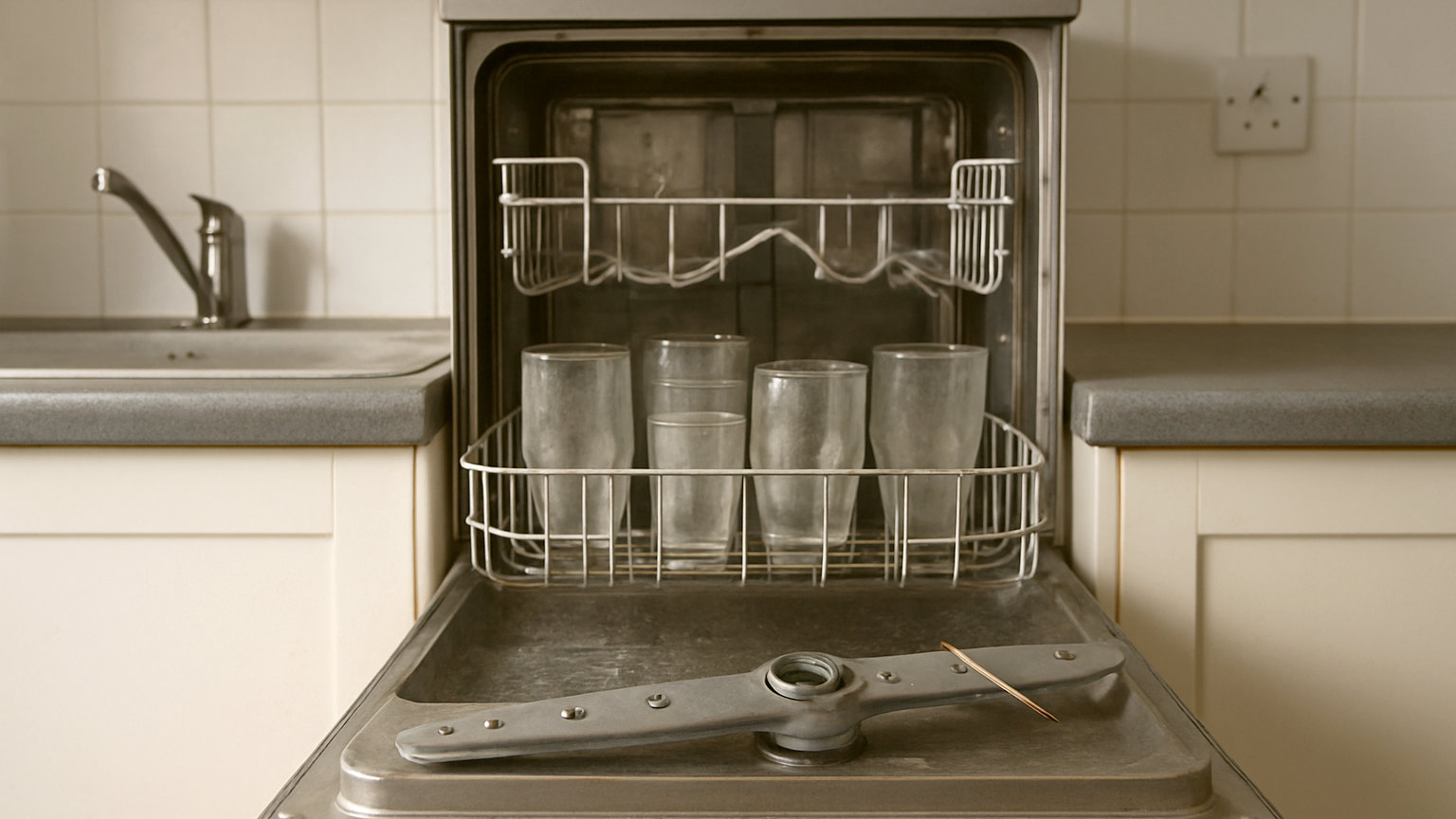
A dishwasher cleans entirely through the water jets in its spray arms. When a jet blocks, the section of the load it covers does not get washed, which produces the distinctive symptom of one area coming out dirty while everything else is fine.
How do you know they need cleaning?
- One part of the load consistently comes out dirty.
- The top rack cleans poorly while the bottom is fine, or the reverse.
- The arms do not spin freely when turned by hand.
- Visible debris or white scale around the jets.
- General decline in performance despite a clean filter.
How do you remove them?
The lower arm usually lifts straight off, or unclips with a quarter turn of a central nut. The upper arm is normally held by a plastic nut that unscrews, often anticlockwise but sometimes the reverse.
Some machines have a third arm at the top of the tub for the cutlery tray, which also comes off.
Check the manual rather than forcing anything, since the retaining nuts are plastic and crack easily.
What is the method?
- Remove each arm.
- Run hot water through from the centre hole and see whether it comes out of every jet.
- Clear each blocked jet with a cocktail stick, a toothpick or a piece of stiff wire.
- Soak the arms in warm water with white vinegar for thirty minutes if there is scale.
- Scrub the outside with an old toothbrush.
- Rinse thoroughly, checking water now comes out of every jet.
- Refit, and spin each arm by hand to confirm it turns freely.
What blocks them?
Limescale in hard water areas, which builds inside the jets and around the openings. Seeds, particularly tomato and raspberry. Fragments of paper labels from jars. Bits of rice. And grease combined with any of the above.
A blocked filter contributes directly, since debris that should have been caught is recirculated into the arms.
What about scale inside the arm?
Soaking in white vinegar or a citric acid solution deals with it, and it needs long enough to work. Thirty minutes to an hour, with the arm fully submerged, then rinsed through.
In a hard water area this is worth doing quarterly alongside a descaling cycle for the machine itself.
Why might an arm not spin?
Usually something in the load catching it: a pan handle poking through the rack, a tall utensil, or an item that has shifted. Spin each arm by hand after loading and before closing the door, which takes two seconds.
An arm that will not spin with the machine empty may have a worn bearing or a blocked feed, which is a repair.
What else should be checked at the same time?
The feed point where the upper arm connects to the water supply, usually a small pipe at the back of the tub, which can block. And the filter, which should be done first since debris from it ends up in the arms.
How often?
Every couple of months in a hard water area, twice a year elsewhere, and immediately if part of a load is coming out dirty. It takes ten minutes and it is one of the few dishwasher repairs that is entirely free.
How do you check the spray pattern?
Hold the arm over a sink and pour water into the central opening, watching whether it emerges from every jet with roughly equal force. A jet that dribbles while its neighbours run freely is partly blocked. Checking this way is far more reliable than looking at the holes, since a jet can be clear at the surface and blocked just behind it.
Do they wear out?
They can. The bearing the arm spins on wears over many years, and a worn one wobbles and sprays unevenly. Cracks in the arm itself also occur and cause a loss of pressure. Both are replaceable parts on most machines and are inexpensive compared with the cost of persistently poor washing.