A dishwasher that has stopped cleaning properly almost always has one of six problems, and most of them cost nothing to fix. Working through them in order takes about twenty minutes and resolves the great majority of cases.
Is the filter blocked?
The most common cause by a wide margin. A filter full of debris means dirty water is being recirculated over the load, so everything comes out with a gritty film.
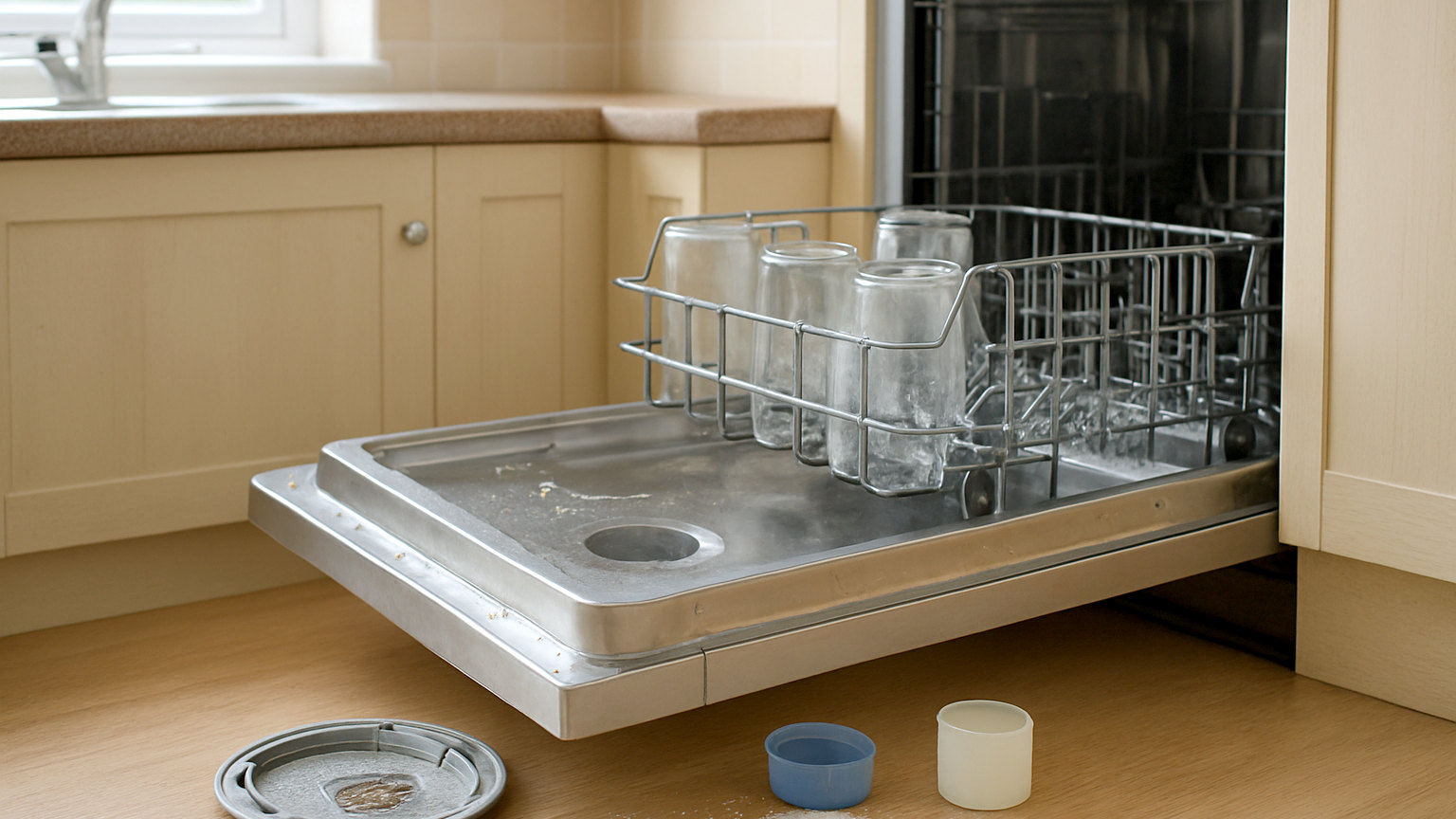
Pull out the bottom rack, twist and lift the filter out, rinse and scrub it, and wipe the sump underneath. Do this first, before investigating anything else.
Are the spray arms blocked or stuck?
Each arm has a series of jets that block with seeds, labels and limescale. A blocked jet leaves a section of the load unwashed, which usually shows as one area coming out dirty while the rest is fine.
Unclip each arm, run water through it, and clear the jets with a cocktail stick. Check both arms turn freely by spinning them by hand with a load in.
Is it overloaded or loaded badly?
Water has to reach every surface. Plates touching each other, bowls nested, items shielding each other or a pan handle stopping the spray arm all produce the same result.
Load with space between items, everything dirty facing the centre, and nothing blocking the arms or the detergent dispenser.
Is the water hot enough?
Most dishwashers heat their own water, and a failing heating element shows as dishes that are not clean and not dry. Open the machine mid cycle: the interior should be genuinely hot.
If the machine takes a cold fill and the element has failed, the wash will be lukewarm and greasy items will not clean. That needs an engineer.
Scale on the element in a hard water area reduces its effectiveness, which a descaling cycle addresses.
Is the detergent the problem?
- Old tablets, which absorb moisture and lose effectiveness. Store them sealed and dry.
- The dispenser blocked by a tall item, so it cannot open.
- Tablet placed in the base of the machine rather than the dispenser, so it dissolves during the pre-wash and is drained away.
- Too little detergent for a heavily soiled load.
- The wrong product, such as rinse aid in the detergent compartment.
Is the programme too short?
Eco and quick programmes use less water and lower temperatures, and they are not designed for heavily soiled loads. An eco cycle runs long and cool, which suits everyday plates and struggles with baked on pans.
Use a normal or intensive programme for anything greasy or baked on, and save the short cycles for lightly soiled loads.
What about baked on food?
No dishwasher removes genuinely baked on deposits. Roasting tins, casserole dishes and anything with a burnt layer should be soaked in hot water with a little washing up liquid first, or washed by hand.
Scraping plates into the bin before loading is worth doing. Rinsing them under a tap is not, and can actually reduce cleaning performance.
What is the checklist?
- Clean the filter and the sump.
- Clear and check the spray arms.
- Load with more space and nothing blocking the arms.
- Run a hot empty cycle with a dishwasher cleaner or citric acid.
- Check the detergent is fresh and the dispenser opens.
- Use a longer, hotter programme for greasy loads.
What if only the top rack is affected?
That points to the upper spray arm or its water feed. Check the arm spins freely, clear its jets, and look at the small feed pipe at the back of the tub where water is delivered to it, which can block with debris. A top rack that is loaded too tightly produces the same symptom, so check the loading before assuming a fault.
Has anything changed recently?
Worth asking, because a machine that washed well last month and poorly this month has usually had one thing change. A new detergent, a different programme, a move to eco mode, a rack adjusted, or an item newly being loaded that blocks a spray arm are all common. Identifying the change is quicker than working through every possible fault.