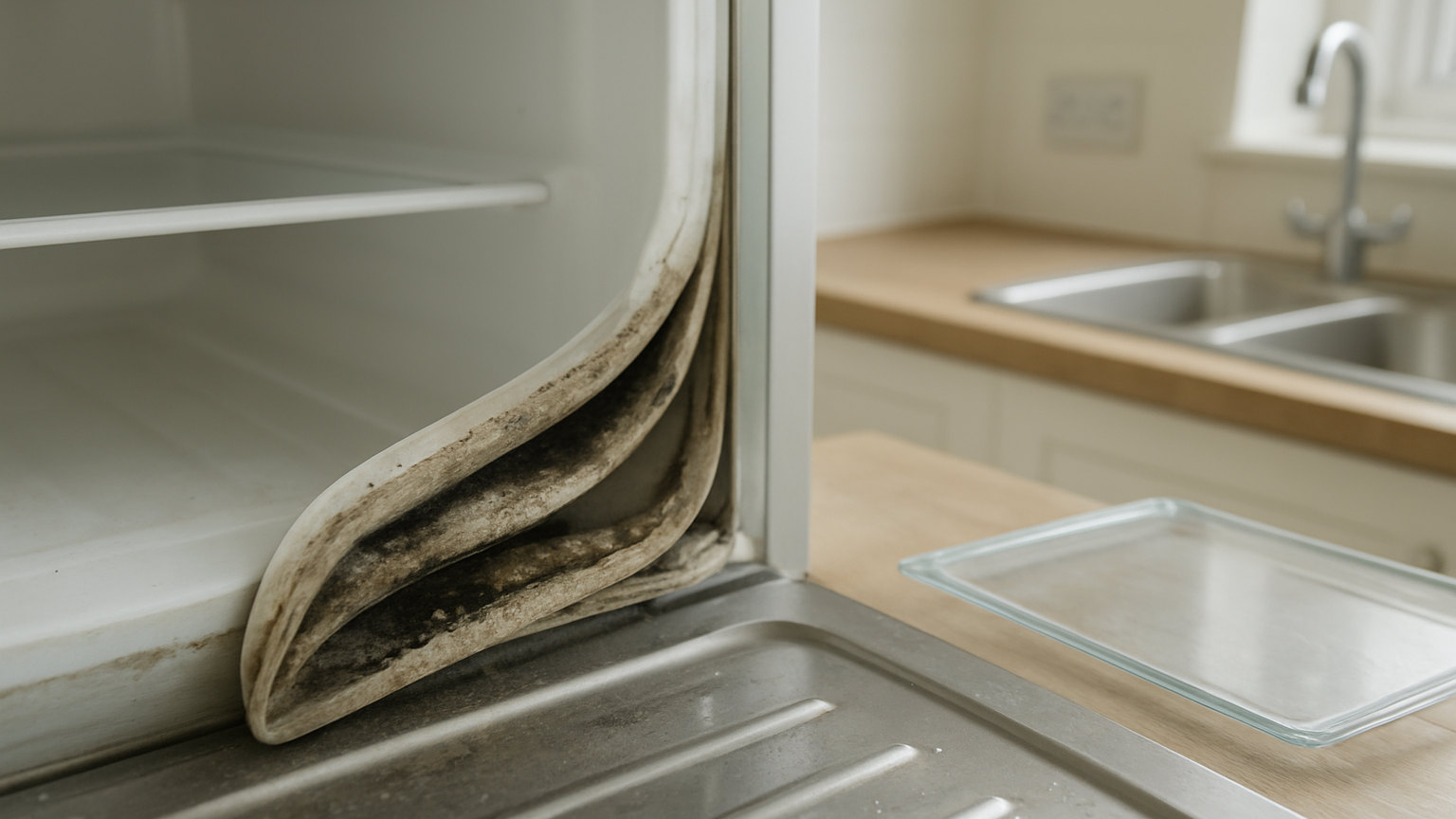
The rubber gasket around a fridge door is the part most likely to grow mould and the part least likely to be cleaned. It has deep folds that trap crumbs and moisture, it is in constant contact with condensation, and it is easy to wipe the front of it and think the job is done.
Why does it matter?
Two reasons. It is a food safety issue, because mould in the seal is a few centimetres from everything in the fridge. And it is an efficiency issue, because a seal held open by debris or hardened with age lets warm air in continuously, which makes the compressor run more, raises the running cost and causes condensation and ice.
What is the method?
- Open the door fully and pull the seal gently outwards so the folds open.
- Wipe into each fold with a cloth wrapped around a finger, or a cotton bud for tight corners.
- Use warm water with washing up liquid, or a bicarbonate of soda solution.
- Work along the whole length, including the bottom edge, which is usually the worst.
- Pay attention to the corners, where the seal is welded and debris collects.
- Rinse with a clean damp cloth.
- Dry thoroughly, since a damp seal grows mould again quickly.
An old toothbrush is useful for the corners and the welded joints.
What works on mould in the seal?
A solution of white vinegar in water, applied with a cloth and left for a few minutes, which has a genuine antifungal effect and is safe around food. Follow with a clean damp cloth and dry thoroughly.
Bleach is effective and degrades rubber over time, taints the fridge and is difficult to rinse out of the folds. Avoid it unless nothing else works, and rinse very thoroughly if you use it.
How do you test whether it still seals?
Close the door on a sheet of paper so half is inside and half outside, then pull. There should be noticeable resistance. If the paper slides out easily, the seal is not making contact at that point.
Test at several points around all four sides, including the corners and the hinge side, since a seal often fails in one area rather than uniformly.
Another test is to shine a torch inside with the door closed in a dark kitchen and look for light escaping.
What if the seal has gone hard or flat?
Rubber stiffens with age and takes a permanent set where it has been compressed. Warming it gently with a hairdryer on a low setting, then closing the door and letting it cool, sometimes restores the shape enough to seal again.
A light smear of petroleum jelly along the contact face can also improve a seal that is dry and sticking, and it should be used sparingly.
A seal that is cracked, torn or permanently deformed needs replacing. They are available as spare parts for most models, they are not expensive, and on many fridges they simply push into a channel without tools.
What causes a seal to fail early?
- Crumbs and debris preventing contact.
- Pulling the door open by the seal rather than the handle.
- Overfilling the door racks, so the door does not close square.
- An unlevel appliance, which twists the door frame.
- Cleaning with bleach or solvents, which degrade the rubber.
How often should it be done?
Wipe the front of the seal weekly with everything else, and do the folds properly monthly. It takes five minutes and prevents both the mould and the premature failure.
Does the same apply to a freezer?
Yes, and the consequences are more visible. A freezer seal that is not sealing lets in warm moist air, which is the most common cause of rapid ice build up and of frost in a frost free model.
What about the seal on an integrated appliance?
Same job, with the added complication that the cabinet door is attached to the appliance door by sliding brackets. If the seal has stopped making contact along one edge, check the alignment of those brackets before replacing anything, since an integrated door that has dropped slightly will twist the appliance door and open a gap at one corner.