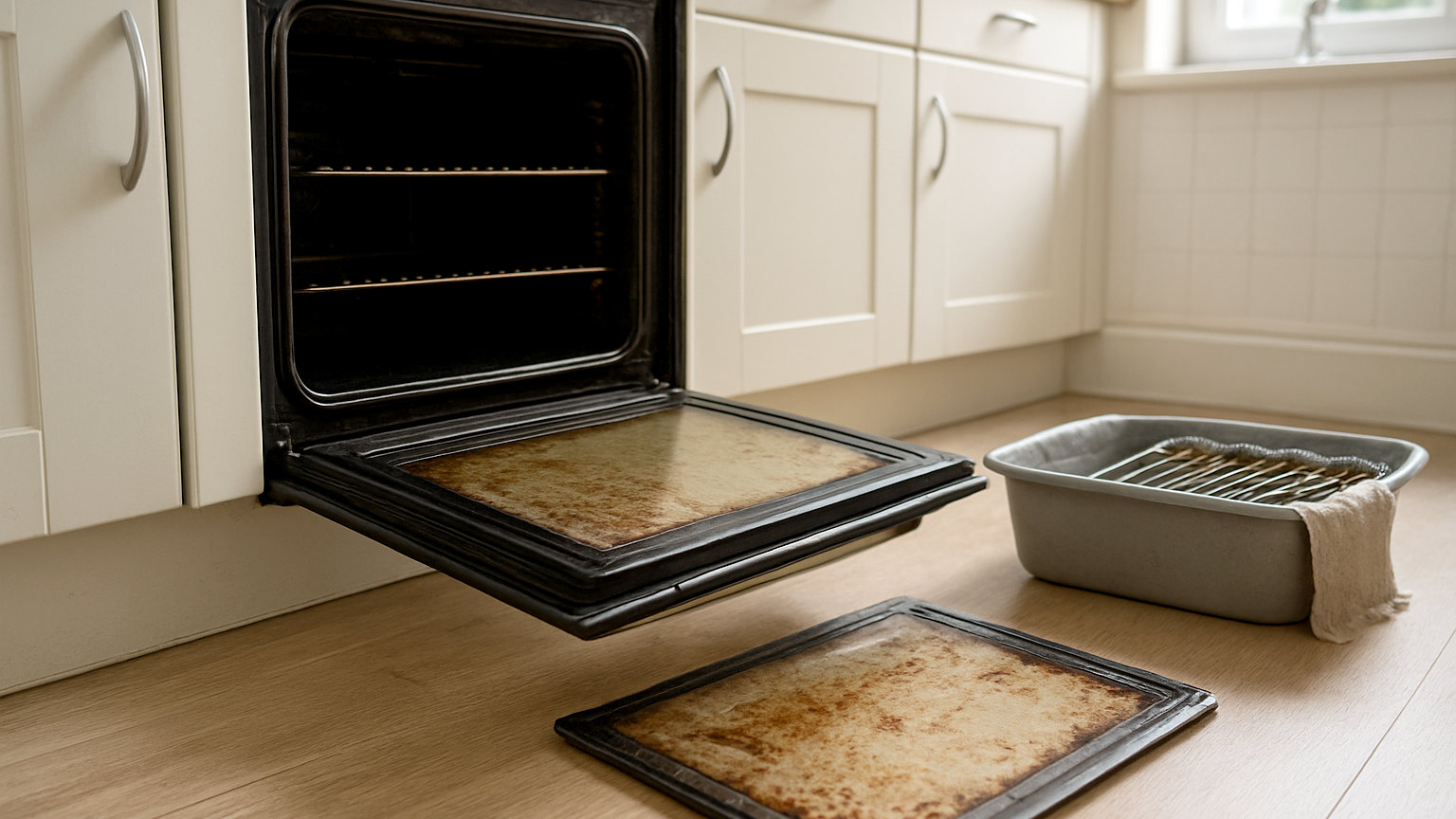
Oven door glass takes the most baked on grease in the whole appliance, because it is directly in the line of anything that spits. Most of it comes off with a mild abrasive and patience. The frustrating case is a brown haze that survives every attempt, which is almost always on the inside surfaces of the double glazed panes rather than on the face you can reach.
What is the method for the inner face?
- Let the oven cool completely.
- Mix bicarbonate of soda with a little water into a thick paste.
- Spread it over the glass and leave it for at least thirty minutes, or overnight for a heavy deposit.
- Work it over with a damp non-scratch pad or a nylon brush.
- For stubborn spots, use a glass safe scraper blade held at a shallow angle with the glass wet.
- Wipe away with a damp cloth, spraying white vinegar to help lift the residue.
- Finish with a clean damp cloth and buff dry.
The soak is what does the work. Scrubbing dry baked grease is slow and mostly futile.
Can you use a scraper blade?
On plain oven door glass, yes, and it is the fastest way to remove hard deposits. Use a proper glass scraper with a fresh blade, keep the glass wet, and hold the blade at a shallow angle of about thirty degrees.
Never use it dry, never on glass with a printed pattern or a coating, and never on the outer decorative panel. Test at the edge first.
Why is there a haze between the panes?
Because oven doors have two or three panes with an air gap, and vapour from cooking gets in through small gaps around the edge. Over years it deposits a fine brown film on the inner surfaces, which cannot be reached without separating the panes.
It is a manufacturing reality rather than a fault, and it is the most common oven cleaning question there is.
How do you clean between the panes?
Two approaches. The proper one is to remove the door and separate the glass, which on most ovens means unclipping the door from the hinges, removing a few screws along the top edge of the door and lifting the panes out. Photograph everything as you go, note which way round each pane faces, and keep the spacers.
The improvised one is to poke a microfibre cloth wrapped around a thin stick or a wire coat hanger through the ventilation slots along the bottom edge of the door, which many ovens have. It is fiddly and works reasonably.
Check the manual before removing a door, since the method varies and some doors are not designed to be opened.
What should you avoid?
- Caustic oven cleaner on the glass, which can etch it permanently and damage any printing.
- Scouring pads and wire wool, which leave fine scratches that hold grease.
- Cleaning hot glass, which risks cracking it through thermal shock.
- Spraying liquid into the door vents, which puts moisture where it cannot dry.
What about the outer glass?
Ordinary kitchen grime rather than baked on deposit. Warm water with washing up liquid, then dry and buff with a microfibre cloth. Avoid abrasives on any printed area, since the markings are surface applied and will wear away.
What about a door that has gone cloudy overall?
A uniform cloudiness across the inner pane is usually a thin baked film rather than damage, and it responds to a long bicarbonate soak followed by a scraper. Cloudiness that does not improve after two treatments is etching, caused either by caustic cleaner or by years of heat, and it is permanent. Replacement glass is available for most ovens as a spare part.
How do you keep it clear?
Wipe the inner glass while the oven is still warm after any session with spitting, which takes seconds and prevents the deposit forming at all. Use a roasting tin with higher sides, cover dishes where practical, and deal with any spill on the same day rather than at the weekend.
A door wiped weekly never needs a scraper, and the glass is the part of an oven that people actually look at every day.