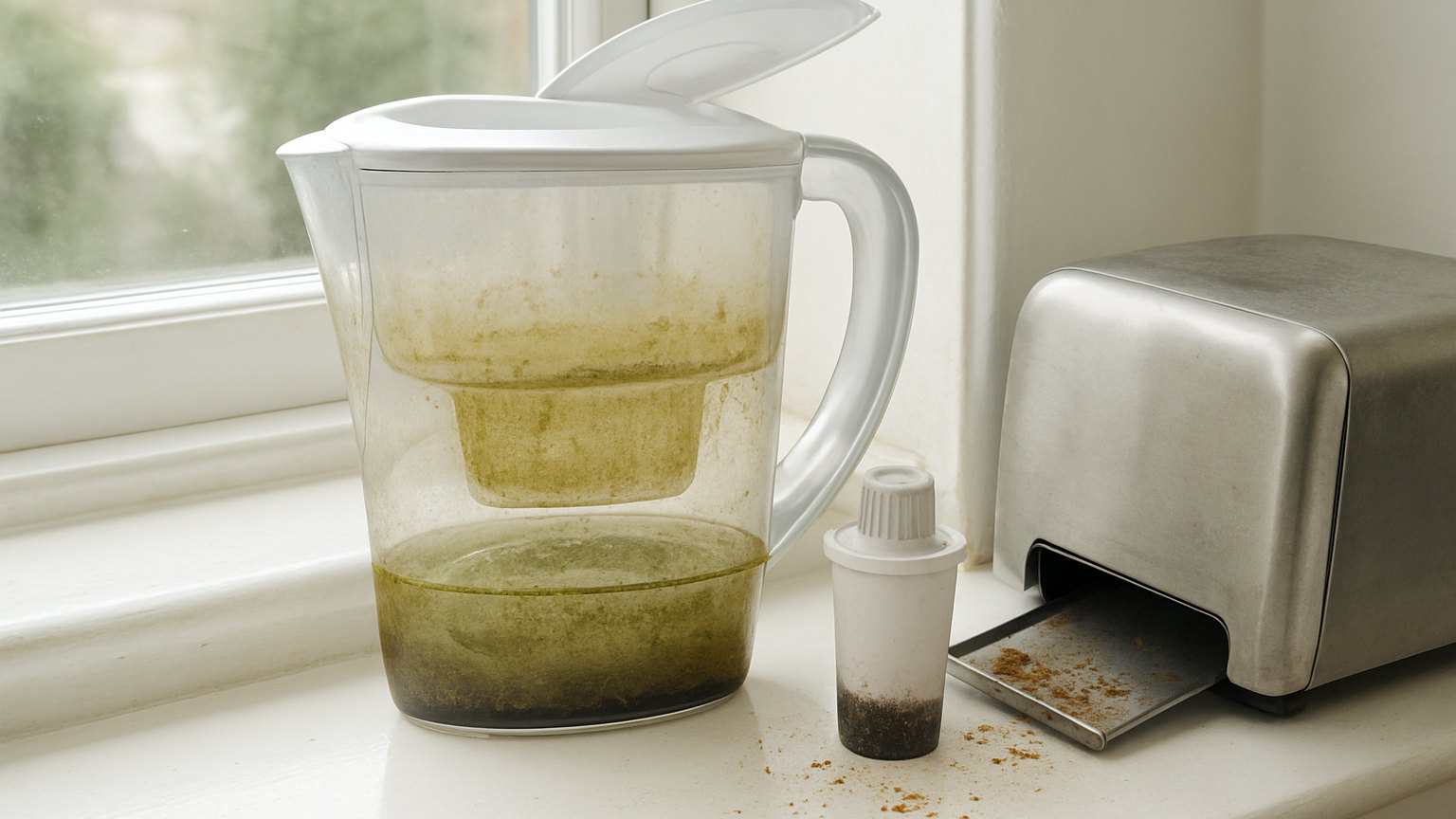
A water filter jug sits on a worktop or in a fridge holding still water at room temperature, frequently for days. That is a good environment for bacteria, and the filter cartridge does nothing about growth that happens after the water has passed through it. The jug needs washing like any other container.
What is the routine?
- Take the jug apart: lid, reservoir, cartridge and body.
- Remove the cartridge and set it aside on a clean surface.
- Wash the jug, reservoir and lid in warm soapy water with a soft sponge.
- Pay particular attention to the underside of the lid and the pouring spout.
- Rinse thoroughly, since detergent residue affects the taste.
- Dry, or leave to air dry, then reassemble.
Weekly is a reasonable interval, and more often in warm weather or if the jug lives on a worktop rather than in the fridge.
What is the slime on the lid?
Biofilm, the same greyish film that forms in any container holding standing water. It is not caused by a fault with the filter and it is entirely normal on a jug that has not been washed.
It collects most on the underside of the lid, around the reservoir rim and in the spout, all of which are easy to miss when giving the jug a rinse.
Can it go in the dishwasher?
Some jugs are dishwasher safe on the top rack and many are not, since the plastic crazes and the electronic cartridge indicator on the lid will be damaged. Check the manual.
Hand washing takes two minutes and avoids the risk.
How often should the cartridge be changed?
Typically every four weeks or around one hundred litres, whichever comes first. Most jugs have an indicator, which is usually based on time or on the number of lid openings rather than actual performance.
An overdue cartridge stops filtering effectively and can become a site for bacterial growth itself, which is the main reason not to stretch the interval.
How do you fit a new cartridge?
Soak it in cold water for the time stated on the packet, usually a few minutes, then rinse it under running water to flush out loose carbon fines. Fit it, then discard the first two or three jugs of filtered water.
The first few jugs may look cloudy or contain black specks, which is carbon dust and is expected.
Does the filter make water safe?
Mains water in the UK is already safe to drink. A jug filter reduces chlorine taste, limescale and some impurities, which is a matter of taste and of scale reduction rather than safety.
It is not a purifier and it does not make unsafe water safe. Filtered water should be treated as more perishable than tap water, since removing the chlorine also removes the residual protection, which is another reason to keep the jug clean and refrigerated.
What about limescale in the jug?
A white film builds in hard water areas despite the filter. Soak the jug parts in a solution of white vinegar or citric acid for thirty minutes, then wash and rinse thoroughly.
Do not soak the cartridge in anything, and do not use vinegar with it in place.
How should it be stored?
In the fridge if there is room, which slows growth considerably. Empty it if it will not be used for a few days rather than leaving water standing.
If a jug has been unused for more than a week, discard the water, wash the jug and fit a fresh cartridge rather than resuming with the old one.
What about a plumbed in or tap filter?
The same principle on a different scale. The cartridge has a stated life and the fittings need occasional attention, particularly the spout on an under sink system where the water leaves. Follow the manufacturer interval rather than judging by taste, since a cartridge stops working long before the water tastes different.