Tailored trousers are made with a crease pressed in at the factory, running down the centre of each leg from the front of the waistband to the hem. Ironing them is a matter of finding that existing line and reinforcing it, not of deciding where a crease should go. Putting a second crease in the wrong place is difficult to undo.
How do you find the existing crease?
Lay the trousers flat and hold them up by the waistband so the legs hang freely. Bring the two side seams together, the inside leg seam and the outside leg seam, and let the fabric fall naturally. The fold that forms at the front and the back is the original crease line.
On a well made pair the line will be faintly visible even after washing. Check the hem, where the crease is usually sharpest and easiest to see.
What is the order of work?
- Pockets first. Turn them inside out and press them flat, then tuck them back in. A creased pocket bag shows through as a bulge.
- The waistband, worked around the narrow end of the board so it sits flat.
- The top section and the seat, one side at a time over the narrow end of the board.
- The legs, laid flat with the seams aligned, working from the hem upwards.
- The crease, pressed firmly along the fold line on both legs.
- A final press on the hem, where the crease matters most visually.
How do you press the crease sharply?
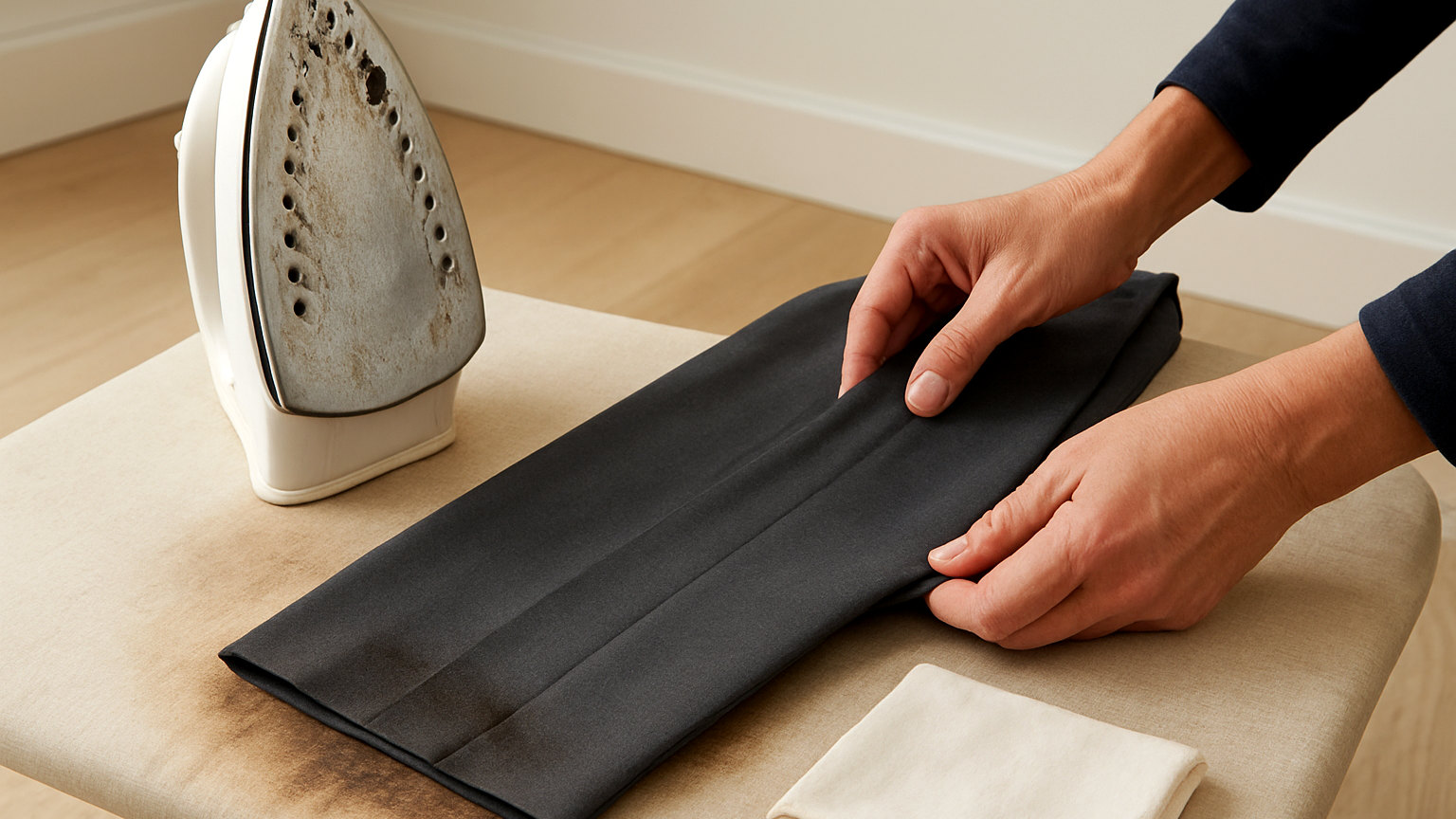
Line the leg up flat with the seams together, smooth the fabric by hand, then press along the fold with a pressing cloth over the top. Use steam and hold the iron in place for a few seconds rather than sliding it, then lift and move along.
Do the upper leg first while the lower leg hangs off the board, then move down. Turn the trousers over and press the same crease from the other side, which sets it properly through the full thickness.
Let the trousers cool on the board or on a hanger before moving them. Fabric sets as it cools, and folding warm trousers undoes the work.
Why does a pressing cloth matter here?
Because trouser fabric is usually wool or a wool blend in a dark colour, which is the combination most prone to shine marks. The crease is pressed with more heat and pressure than anywhere else on the garment, so it is exactly where shine appears.
A cotton cloth between the iron and the fabric prevents it entirely, and on dark trousers it is not optional.
How do you make the crease last?
Press it well with plenty of steam so the fibres genuinely reset, let the garment cool fully before it is moved, and hang the trousers from the hem on clip hangers so the weight of the fabric keeps the line straight.
Folding trousers over a bar hanger at the knee puts a horizontal crease across the leg that fights the vertical one. If you must use a bar hanger, fold them along the crease line rather than across it.
Which trousers should not have a crease?
Jeans, chinos in casual wear, cords, and most modern flat front trousers designed without one. Corduroy in particular should never be pressed with a crease, and should be ironed inside out with a cloth to avoid crushing the pile.
If a pair has no visible original crease, it was probably not made with one, and adding one changes the way the garment is meant to look.
What if a crease is in the wrong place?
Dampen the area thoroughly with a wet pressing cloth and press it flat from the reverse side, then let it dry completely before pressing the correct line. Wool usually responds well. A crease that has been repeatedly pressed into cotton over years may leave a faint permanent line.