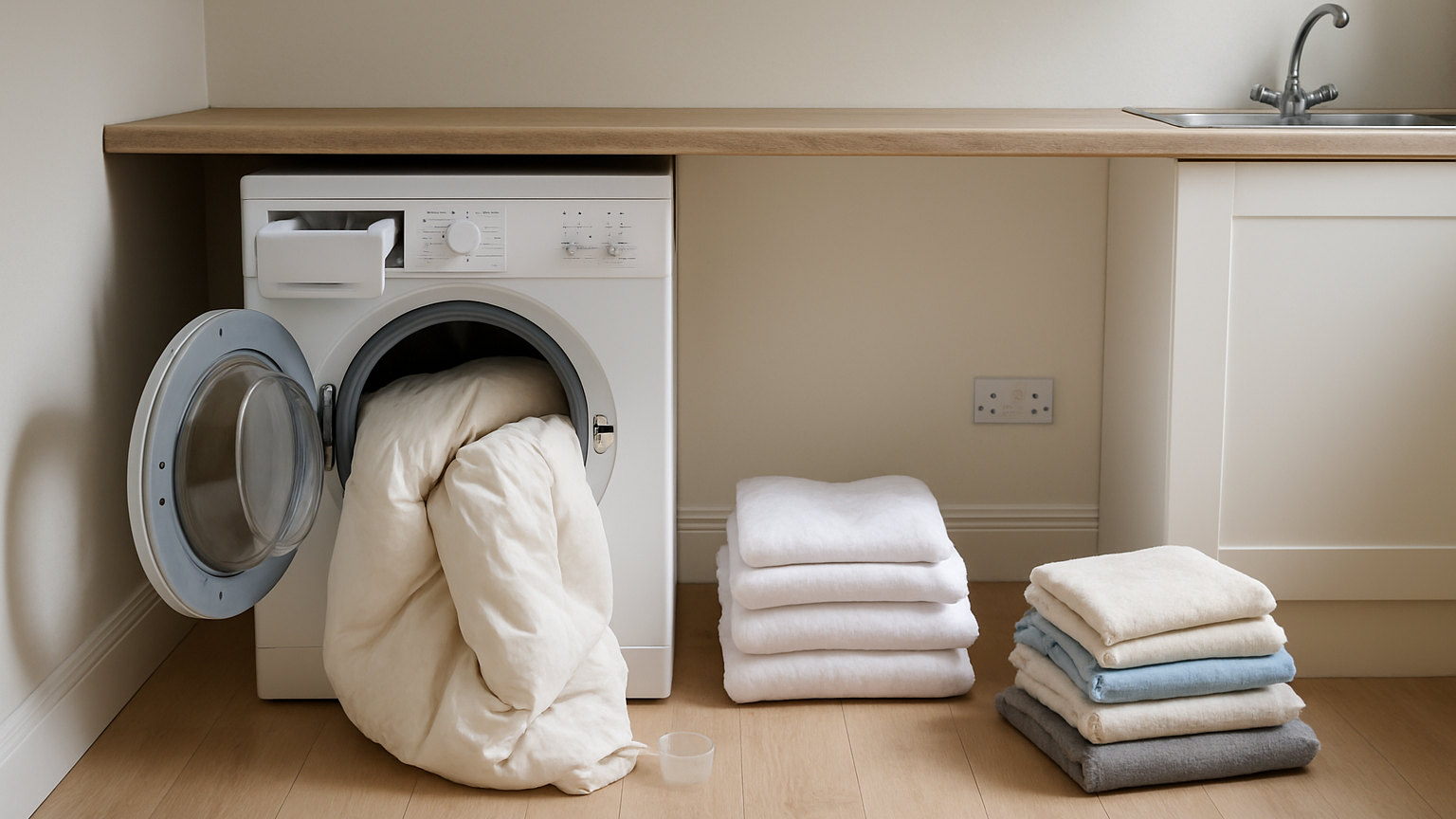
Bedding is the load most likely to defeat a domestic washing machine, and the reason is bulk rather than weight. A machine rated at 8kg will take 8kg of dry cotton, but a king size duvet weighing far less than that may still be too bulky to tumble freely, which means it never gets properly washed or rinsed.
What fits in a domestic machine?
- 7kg machine – a single duvet, or a double duvet cover and sheet set.
- 8kg machine – a double duvet, or a king size cover set.
- 9kg and above – a king size duvet, at a push.
- Pillows – two at a time in most machines, which also keeps the load balanced.
The test is whether the item can move. Push it into the drum and see whether there is still space around it. A duvet compressed into a solid block will come out with detergent still in it.
What temperature should bedding be washed at?
Sixty degrees for sheets, pillowcases and duvet covers where the fabric allows, since that is the temperature at which dust mites are reliably killed. Cotton handles it well. Linen, bamboo and anything with elastane in a fitted sheet usually specify lower, so check the label.
Where 60 is not possible, wash at 40 and tumble dry hot, which achieves a similar result through the heat of the drum.
Why do duvet covers swallow everything?
Because an open cover behaves like a bag. It fills with the rest of the load during the wash, which stops both the cover and its contents from being cleaned or rinsed properly, and it badly unbalances the drum during the spin.
Fasten every button or press stud before washing, and where possible wash covers with items of a similar size rather than with socks and pillowcases.
How do you keep the load balanced?
Mix sizes so smaller items fill the gaps, and avoid washing one large heavy item alone, which is the classic cause of a machine banging and walking across the floor during the spin. If the machine stops and restarts the spin repeatedly, it is trying to redistribute an unbalanced load, and opening the door to shake the item out usually solves it.
A slightly lower spin speed on bulky items helps and costs only a little extra drying time.
What about pillows and duvets themselves?
Check the label first. Polyester and hollowfibre wash well at 40 or 60. Feather and down usually wash at 40 on a gentle cycle. Wool often specifies a wool cycle or dry cleaning. Memory foam and latex must never go in a machine at all.
Use half the usual detergent, skip conditioner entirely, and add an extra rinse, because bulky fillings hold detergent stubbornly. Drying matters more than washing: tumble dry on low with dryer balls, stopping regularly to shake and redistribute the filling, and never put anything away until it is completely dry all the way through.
When should you use a launderette?
For king and super king duvets, for multiple duvets at once, and for anything that will not move freely in your own drum. Commercial machines are far larger, and their dryers are considerably more powerful, which solves the drying problem as well as the washing one.
It is usually cheaper than replacing a duvet that has been ruined by being washed in a machine too small for it.
How do you dry large items without a dryer?
Outdoors on a warm breezy day is ideal, spread over two lines rather than folded over one, so air reaches both faces. Turn and reposition it every couple of hours. Indoors, drape it over a banister or several airers rather than in a single fold, keep a window open and ideally run a dehumidifier in the same room.
Never put bedding away while any part of it is cool or heavy to the touch. Damp filling stored in a cupboard develops mould and a smell that cannot be washed out afterwards.