Hand washing exists because some fabrics cannot survive the mechanical action of a drum. The whole technique follows from that: minimal movement, minimal stress on the fibres, and no wringing at any point. Most garments ruined during hand washing are damaged after the washing rather than during it.
What needs hand washing?
Wool and cashmere unless the label permits a wool cycle, silk, lace, anything heavily beaded or embellished, vintage textiles, structured items such as bras, and anything labelled hand wash where you are not confident the machine has an equivalent programme.
Many modern machines have a hand wash cycle that is genuinely gentle and produces excellent results. Where one exists and the label allows it, it is usually kinder than most people are by hand.
What is the method?
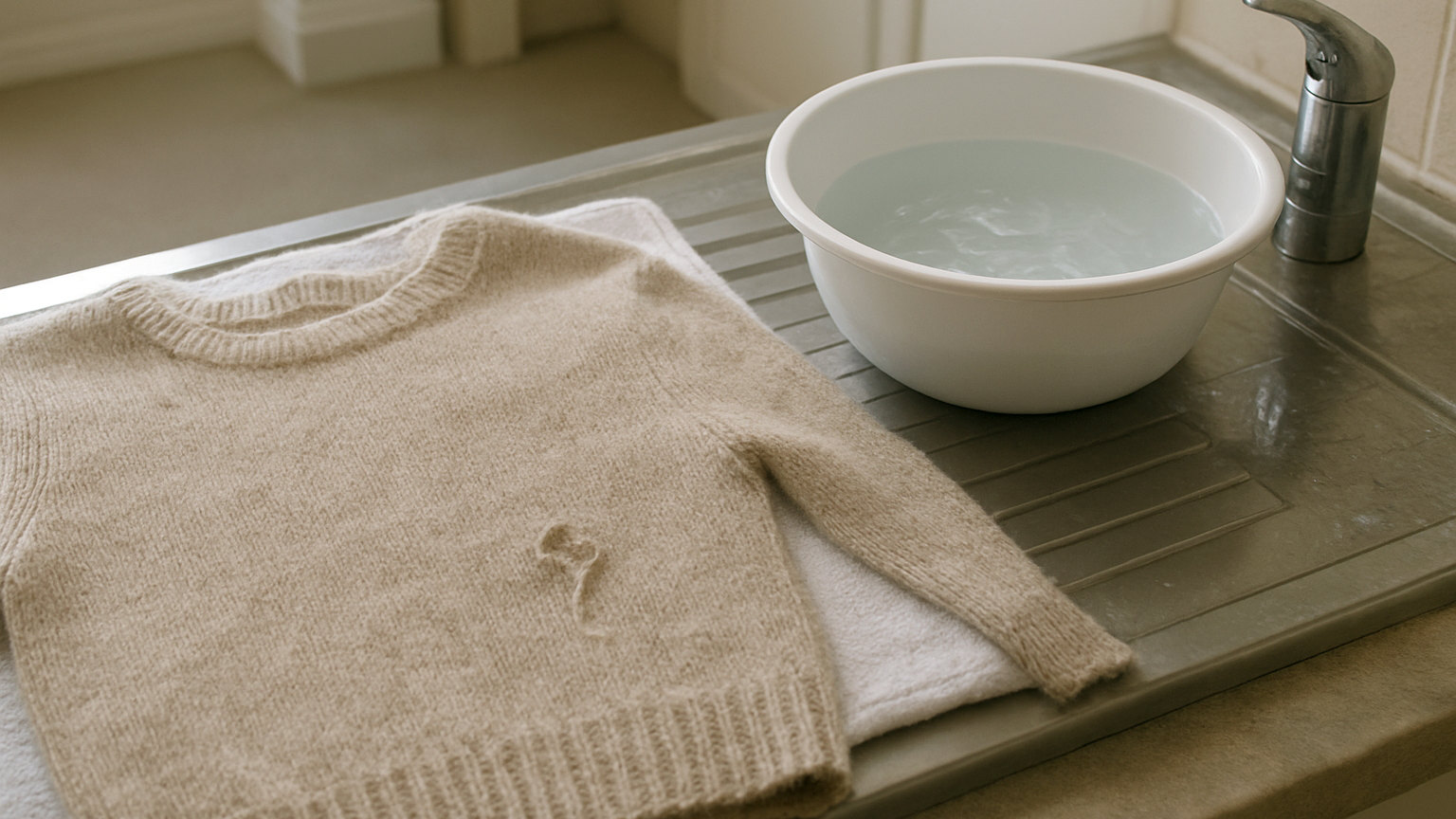
- Fill a clean sink or bowl with water at the temperature the label specifies, which for wool and silk means cool or lukewarm rather than warm.
- Add a small amount of a suitable detergent and mix it into the water fully before the garment goes in.
- Submerge the item and press it gently under the water. Leave it to soak for five to fifteen minutes.
- Squeeze the water through the fabric with an opening and closing motion of the hands. Do not rub, twist, scrub or stretch.
- Drain, refill with clean water at the same temperature, and squeeze through again.
- Repeat the rinse until no suds appear and the water runs clear.
Why should the detergent go in first?
Because concentrated detergent in contact with fabric can cause patchy discolouration, particularly on silk and on dark wool. Mixing it into the water fully before the garment is added avoids that entirely, and it takes ten seconds.
Use a detergent suited to the fibre. Wool and silk are protein fibres and will be damaged by the enzymes in a biological detergent, so a specific wool or delicates wash is worth having.
Why does temperature matter so much?
Wool felts irreversibly when it meets a combination of heat, moisture and agitation together. The microscopic scales on the surface of each fibre open up and interlock with their neighbours, and the garment shrinks and thickens permanently as a result. Keeping the water cool and the handling gentle is what prevents it, and there is no way to undo it afterwards.
Sudden temperature changes matter too. Rinsing a wool garment washed in warm water under a cold tap can shock the fibres, so keep the wash and rinse water at a similar temperature.
How do you get the water out safely?
Never by wringing, which stretches and distorts the fabric and breaks fibres. Instead, lift the garment supporting its full weight with both hands so it does not stretch under its own weight, press it gently against the side of the bowl, then lay it flat on a clean dry towel.
Roll the towel up with the garment inside and press firmly along the roll. The towel absorbs a surprising amount. Unroll, move the garment to a second dry towel and repeat if it is still very wet.
How should hand washed items be dried?
Flat, on a towel or a mesh drying rack, reshaped by hand to their original dimensions while damp. Knitwear hung on a line or a hanger stretches under the weight of the water and never recovers.
Keep items out of direct sunlight and away from radiators. Both fade colour and can make wool brittle. Turn the garment over halfway through drying so both faces get air.
How long does it take?
About ten minutes of actual work per item, plus the soaking time, and a day or two to dry flat afterwards. It is undeniably slower than putting something in a machine, and considerably cheaper than replacing a cashmere jumper that has shrunk two sizes, which is the honest comparison for most of the garments that genuinely need it.