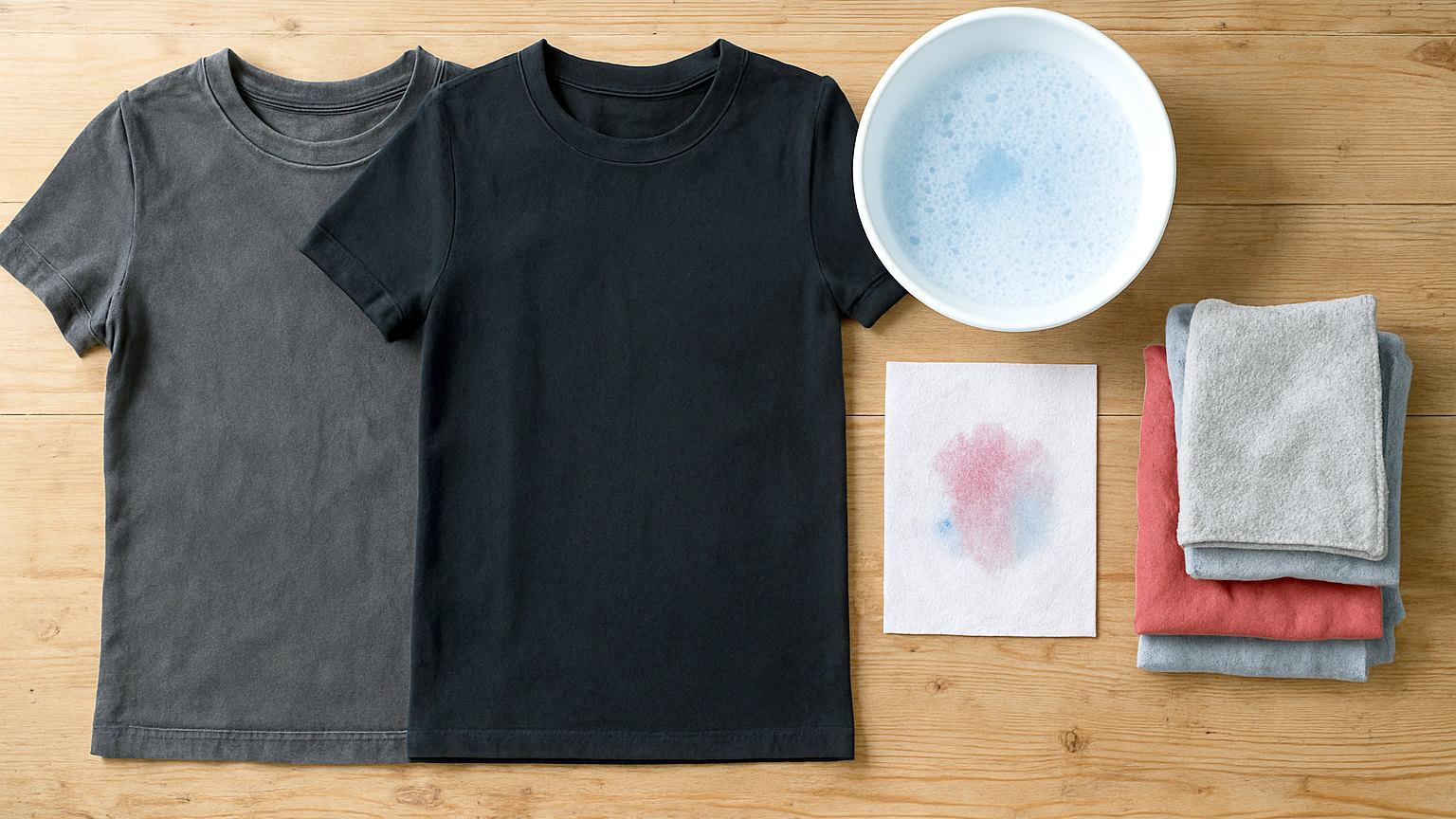
Before trying to restore a black garment, work out why it faded. If the dye has washed out of the fibres, redyeing works well. If the fabric surface has been abraded so that pale fibre cores are showing through, redyeing helps far less, because worn fibres take colour differently and the worn areas stay visible.
How do you tell which it is?
Look at where the fading is. Even, overall fading across the whole garment is dye loss and responds well to treatment. Fading concentrated on the knees, seat, elbows, collar and cuffs is wear, and those areas will remain paler whatever you do.
Run a fingertip over a faded patch. Wear usually feels slightly smoother and thinner than the surrounding fabric.
What does fabric dye do?
A machine or hand dye designed for clothing will restore a cotton garment to a good depth of black, and the results are often better than people expect. Machine dyes are the easiest to use, going into the drum with the garment and running on a long warm cycle.
The critical point is fibre content. Dye bonds to natural fibres such as cotton, linen and viscose. It does not take on polyester, nylon or acrylic. A garment that is 60 per cent cotton and 40 per cent polyester will come out a muted charcoal rather than black.
What about the stitching?
Almost all garments are sewn with polyester thread, which will not take the dye. After dyeing a black garment you will usually have pale grey seams, hems and topstitching against black fabric.
On some items this looks like deliberate contrast stitching and is fine. On others it looks exactly like what it is. Check the seams before deciding, since this surprises more people than any other aspect of home dyeing.
How do you get the best result?
- Wash the garment thoroughly first. Dye will not take evenly over stains, residue or fabric conditioner.
- Check the fibre composition on the label and set expectations accordingly.
- Follow the dye instructions exactly, particularly on quantity and water temperature.
- Do not overload. The garment must move freely or the colour will be patchy.
- Run the full cycle time rather than shortening it.
- Rinse thoroughly afterwards, and run an empty hot cycle to clean the machine.
- Wash the dyed garment separately for the first few washes, since surplus dye will come out.
Are there gentler alternatives?
Colour refresh or black restore products exist and deposit a small amount of colour during a normal wash. They are far less dramatic than a proper dye and are best thought of as slowing the fade rather than reversing it. Used regularly they do keep black clothing looking better for longer.
Washing in a dark specific detergent, without optical brighteners, also removes the pale bloom that brighteners leave on dark fabric, and that alone can make a garment look noticeably deeper.
Does the residue explanation matter?
It does, and it is worth ruling out first. Detergent residue and fabric conditioner build up on dark fabric and scatter light, which makes black look grey even though the dye is intact. Washing the garment two or three times with no detergent and an extra rinse will tell you quickly whether that is the problem.
If it improves, the dye was never the issue.
Is it worth the effort?
For a good quality cotton garment that fits well and has faded evenly, yes. For a heavily worn item with pale knees and shiny elbows, no amount of dye will make it look new, and the honest answer is that the garment has reached the end of its life.
What should you do about the machine afterwards?
Run a hot empty cycle with detergent immediately after dyeing, and wipe out the drum and under the door seal by hand. Residual dye will otherwise transfer into the next load, and black dye on a load of white towels is a bad way to end an otherwise successful project. Check the detergent drawer as well, since dye collects there.