A shower head that sprays sideways, has dead holes, or seems to have lost pressure is almost always scaled rather than faulty. The mineral deposit builds inside the nozzles and the internal channels, and it comes out with acid and time. The job needs no tools and no dismantling, and it takes about ten minutes of attention spread over an hour.
What is the bag method?
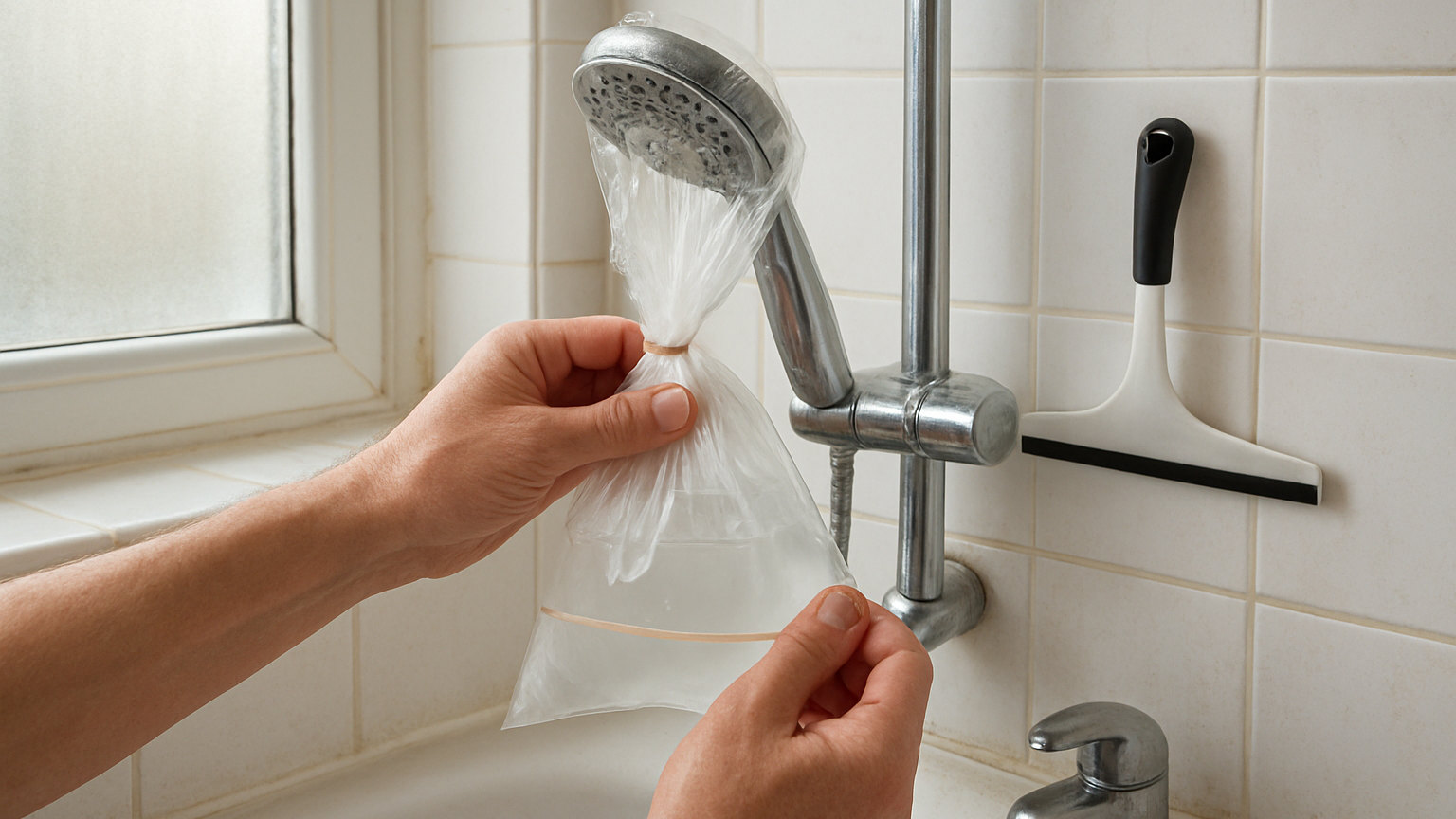
- Fill a strong freezer bag with white vinegar or a solution of citric acid, roughly two tablespoons of citric acid powder in half a litre of warm water.
- Hold the bag up around the shower head so the whole face is submerged.
- Secure it around the neck of the fitting with an elastic band or a cable tie.
- Leave it for one to two hours, or overnight for heavy scale.
- Remove the bag, run the shower hot for a minute to flush the loosened deposit out, and rub the rubber nozzles with a thumb to clear anything left.
If the head detaches from the hose, soaking it in a bowl is easier and lets you clear the inlet filter at the same time.
What about the hose and the inlet filter?
Most shower hoses have a small mesh filter where they screw into the head, and it clogs with scale flakes and grit. Unscrew the head, look inside the connector, and rinse or brush the filter. This is a common cause of poor flow that descaling the face alone will not fix.
How do you descale taps?
The worst affected part is the underside of the spout and the aerator screwed into the end of it, both of which are invisible from above. Wrap a cloth or a strip of kitchen paper soaked in vinegar around the spout, secure it with an elastic band, and leave it for thirty minutes to an hour. Then brush the crevices with an old toothbrush and rinse.
Aerators unscrew by hand or with a cloth for grip, and soaking them separately in a cup of descaler for an hour restores the flow pattern completely. Note the order of the washer and mesh as you take it apart.
Which finishes must not meet acid?
- Matt black, brushed brass, gold and bronze finishes are coated, and acid strips the coating permanently. Use warm soapy water only.
- Nickel and some brushed finishes discolour with prolonged acid contact.
- Chrome tolerates short exposure but not long soaks, so rinse thoroughly and do not leave a vinegar cloth on overnight.
- Natural stone basins or surrounds must never be splashed, as acid etches stone instantly.
When in doubt, check the manufacturer instructions. Replacing a designer tap costs a great deal more than an extra hour of soaking with something milder.
How often does it need doing?
Every one to three months in a hard water area, and twice a year in a soft one. The signal is easy to read: a spray pattern that has gone from straight to scattered, or a shower that feels weaker than it did. Descaling before that point is quicker than descaling after it.
Does scale damage anything beyond the flow?
It shortens the life of the fitting. Scale inside a mixer cartridge makes it stiff and eventually causes it to fail, and scale in a thermostatic shower valve makes temperature control unreliable. Keeping the visible parts clear is a reasonable proxy for what is happening inside.
What stops it building up so fast?
Wiping taps dry after use makes a surprising difference, because scale forms where water evaporates rather than where it flows. Rubbing the rubber nozzles of a shower head with a thumb once a week takes seconds and keeps them clear almost indefinitely.
In a very hard water area, a whole house softener removes the cause entirely. Failing that, an inline shower filter helps a little, though the claims made for magnetic and electronic descalers are not well supported.