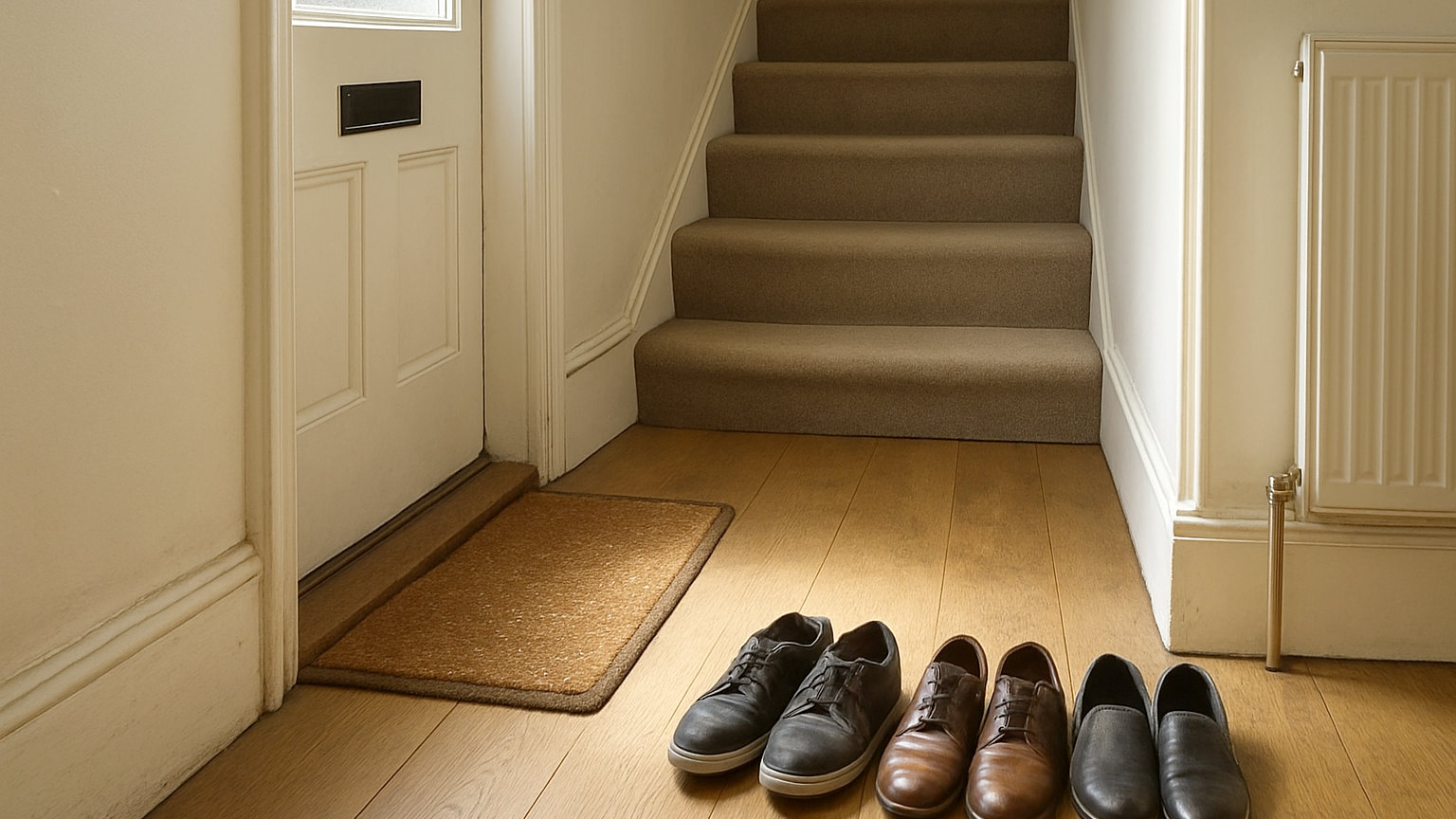
Hallway walls get marked faster than the walls in any other room, and it is not because people are careless. A hall is a narrow space that everyone passes through several times a day carrying bags, coats, shopping and children, and there is nowhere to pass without brushing something against the wall.
Where do the marks actually appear?
- At hand height beside the front door, where people steady themselves while taking shoes off.
- Around light switches, from fingers reaching in the dark.
- At bag and elbow height along the length of the hall, particularly on the side people naturally walk.
- At shoe height on the skirting and the lower wall, from kicked off footwear and vacuum heads.
- On the corner of the wall at the foot of the stairs, which everything gets dragged around.
- Along the stair wall at hand height, where people put a hand out instead of using the banister.
Those six locations account for the overwhelming majority of marks in a typical hall, which is useful because it means the maintenance is targeted rather than general.
Why does matt paint mark so easily?
Because it has a porous, open surface with almost no protective film. That is what gives matt emulsion its depth of colour and its ability to hide imperfections in a wall, and it is also why anything greasy soaks in rather than sitting on top.
Rubbing at a mark on matt emulsion compresses and polishes the surface, leaving a shiny patch that is usually more visible than the original mark. That is the specific failure mode that makes people conclude hallway walls cannot be cleaned.
Which finishes survive a busy hallway?
Washable or scrubbable emulsions, which several manufacturers make specifically for kitchens, bathrooms and high traffic areas. They have a tougher binder and tolerate repeated wiping without burnishing. Soft sheen and vinyl silk are more durable again, though the slight shine shows wall imperfections more clearly.
The practical compromise in many halls is a durable finish on the lower half of the wall and whatever you prefer above it, with a dado rail or a painted line dividing the two.
What physical protection is worth adding?
Panelling on the lower half of the wall is the traditional answer and remains the most effective, since it takes the contact instead of the plaster and can be repainted easily. Corner protectors on the exposed corner at the foot of the stairs prevent the damage that is hardest to repair. Felt pads on the back of any furniture that touches a wall stop the slow rubbing that eventually wears through paint.
How should marks be dealt with?
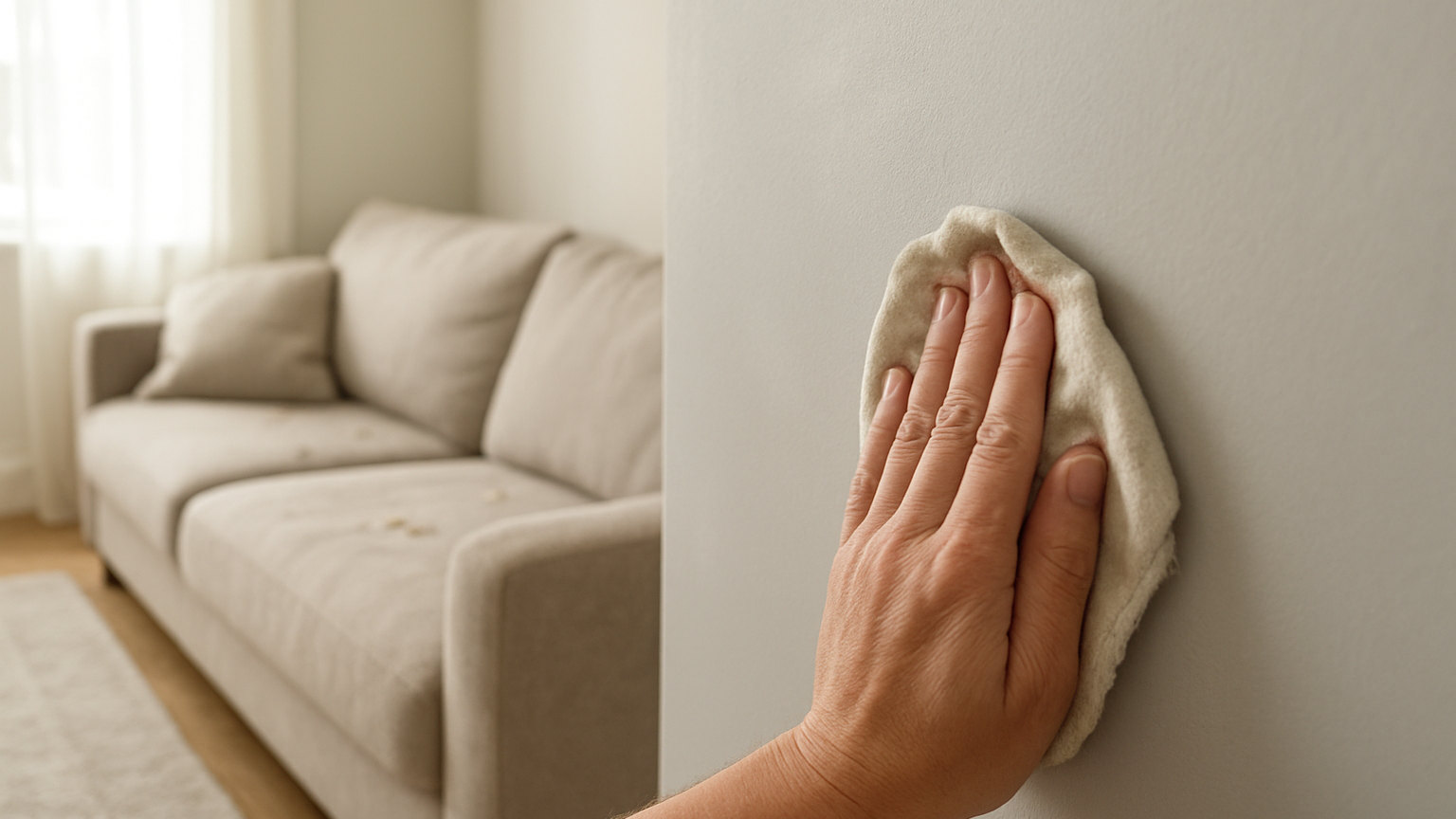
Promptly and gently. A fresh mark lifts with a damp cloth in seconds; a mark left for six months has bonded and often needs touching up. A weekly wipe of the six locations listed above takes two minutes and prevents almost all accumulation.
Start with a dry eraser for scuffs, move to a barely damp cloth with a drop of washing up liquid, and dab rather than scrub. Keep a labelled pot of the hallway paint, because touching up is frequently faster and always better looking than cleaning hard.
How often should a hallway be repainted?
More often than other rooms, and that is simply the nature of the space. Every three to five years in a busy family house, against perhaps ten in a bedroom. Choosing a colour that can be touched up invisibly, and keeping enough paint to do it, spreads that work into occasional small jobs rather than one large one.
Is there an argument for darker colours?
A practical one, yes. Mid and darker tones hide scuffs and fingermarks considerably better than pale neutrals, which show everything. The trade-off is that a narrow hallway with little natural light can feel closed in, so the usual compromise is a darker lower half and a lighter upper half, which also happens to put the durable surface where the contact happens.