An extractor hood filter should be washed every four to eight weeks in a kitchen where cooking happens most days, and every two to three months in one where it does not. Left longer, the filter saturates, stops capturing grease and starts pushing warm greasy air straight back into the room, which is why cupboard doors and ceilings suddenly get sticky in a kitchen that has not otherwise changed.
How can you tell when it needs doing?
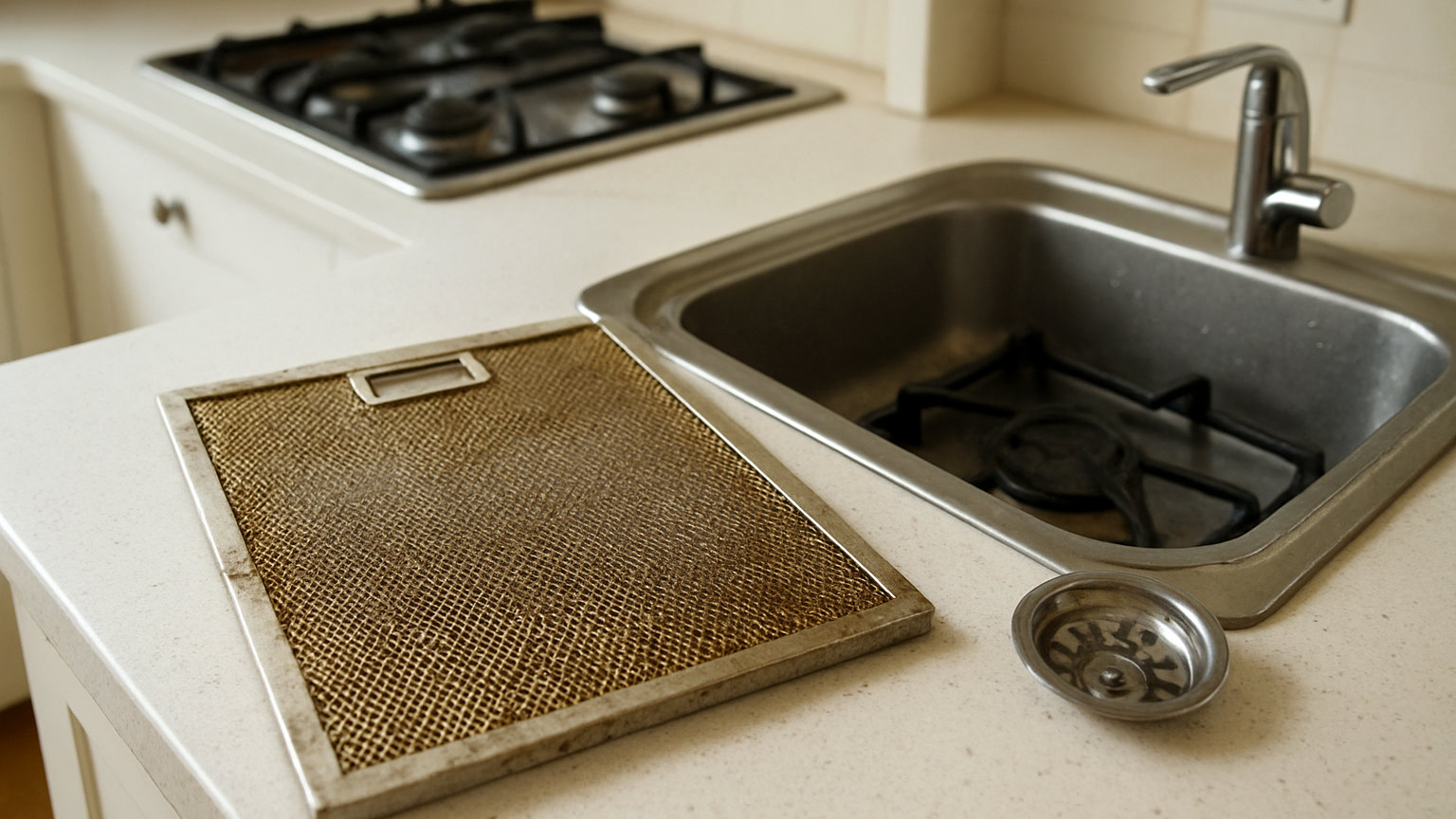
Look at it from underneath with a torch. A metal mesh filter that is due a wash looks dull and yellowish rather than silver, and the mesh openings look partly filled. Press a piece of kitchen paper against it: if the paper comes away marked, the filter is holding more grease than it can take.
The other signals are indirect but reliable. The hood gets noisier because the motor is working against resistance, the kitchen holds cooking smells for longer after you finish, and a greasy film reappears on nearby surfaces within weeks of being cleaned.
Why does a blocked filter matter beyond the mess?
Two reasons. The first is fire risk: accumulated grease sitting directly above a hob is flammable, and hood fires are not rare. The second is that the extraction stops working, which means moisture as well as grease stays in the room, and that eventually shows up as condensation and mould on the coldest wall.
What is the best way to clean a metal filter?
Soaking does almost all of the work.
- Switch the hood off at the wall and release the filter. Most slide back and drop down on a small catch; check the manual if it is not obvious, and support the weight, because a saturated filter is heavier than it looks.
- Fill a sink or a bath with water as hot as the tap gives and add a generous squeeze of washing up liquid plus a few tablespoons of bicarbonate of soda.
- Submerge the filter fully and leave it for twenty to thirty minutes. Rushing this is the difference between wiping and scrubbing.
- Work over it with a soft brush, following the direction of the mesh rather than across it.
- Rinse with hot water until the water runs clear, and check by holding it up to the light. If you cannot see light through the mesh evenly, soak it again.
- Dry completely before refitting. A wet filter put straight back drips onto the hob and traps moisture in the housing.
Can filters go in the dishwasher?
Most stainless steel mesh filters can, on a hot cycle, and it is a reasonable option if the filter fits without blocking the spray arm. Two cautions apply. Aluminium filters often discolour and go chalky grey in a dishwasher because of the alkaline detergent, and the damage is cosmetic but permanent. And a very greasy filter can leave a residue that affects the next load, so run the machine empty afterwards or wash the worst off in the sink first.
What about carbon filters?
Carbon filters are different and cannot be washed. They are fitted to recirculating hoods – the type that has no duct to the outside – and they absorb odours rather than trapping grease. Washing one destroys it. They need replacing every three to six months depending on use, and a hood that has stopped controlling smells while still extracting normally usually needs a new carbon filter rather than a clean.
A ducted hood that vents outside has no carbon filter, only the metal grease filter, which is why ducted hoods cost less to run over time.
What else in the hood needs attention?
The housing above the filter collects grease too, and it is worth wiping with hot soapy water whenever the filter is out, along with the underside of the canopy and the light covers. The outside of the hood picks up the same film as the cupboard doors and cleans the same way. Do not spray anything directly into the fan or onto the light fittings.
Does using the hood more often make it worse?
It fills the filter faster, but that is the filter doing its job. Running the hood while you cook, and for a few minutes afterwards, keeps grease and moisture out of the room, and a filter washed every six weeks is a much smaller task than a kitchen that needs degreasing from ceiling to skirting twice a year.