Catalytic liners are rough, slightly porous panels fitted to the sides and back of some ovens. They contain a catalyst that oxidises grease at normal cooking temperatures, breaking it down into ash and vapour as you cook rather than in a separate cycle. They work quietly in the background and they are ruined by anything applied to them.
How do you tell if you have them?
They look and feel different from ordinary oven enamel: matt, slightly rough, usually a dark speckled grey or black, and noticeably textured compared with the smooth glossy base of the oven. They are fitted to the sides and sometimes the back, never the base or the door.
The manual will confirm it, and it is worth checking before cleaning any oven you have not owned from new.
How are they different from a pyrolytic oven?
A pyrolytic oven runs a dedicated cycle at around 500 degrees to burn everything off at once. Catalytic liners work continuously at ordinary cooking temperatures, from around 200 degrees upwards, oxidising grease as it lands.
Catalytic liners need no programme and no user action beyond cooking hot enough often enough. Pyrolytic cleaning is a deliberate event.
Why must they never be cleaned?
Because the catalyst is in the porous surface, and any cleaner clogs or destroys it. Caustic oven cleaner strips it chemically. Detergent blocks the pores. Abrasives remove the coating physically. Once the catalytic action has been lost, the panel becomes an ordinary rough surface that holds grease and cannot be cleaned easily either.
The damage is permanent and the only remedy is replacement panels, which are available for most ovens and are not cheap.
What if they look dirty?
A catalytic liner that has become shiny or greasy has been overwhelmed rather than broken, usually because the oven has been used at low temperatures for a long period. The remedy is heat rather than cleaning.
Run the oven empty at around 220 to 250 degrees for an hour, with the shelves out. That gives the catalyst the temperature it needs to oxidise the accumulated grease. Repeat if necessary, ventilating the kitchen while it runs.
Many ovens with catalytic liners have a specific cleaning setting that does exactly this.
What if they get a spill on them?
A sugary or starchy spill can bake onto a catalytic panel and will not oxidise away. Scrape off what you can with a plastic scraper, without using any liquid, and then run the high temperature cycle.
Water alone, on a cloth wrung out very well, is sometimes permitted for a specific mark, though most manufacturers advise against even that.
What can you clean in an oven with catalytic liners?
- The base, which is ordinary enamel and needs manual cleaning.
- The door and the glass, both of which need doing by hand.
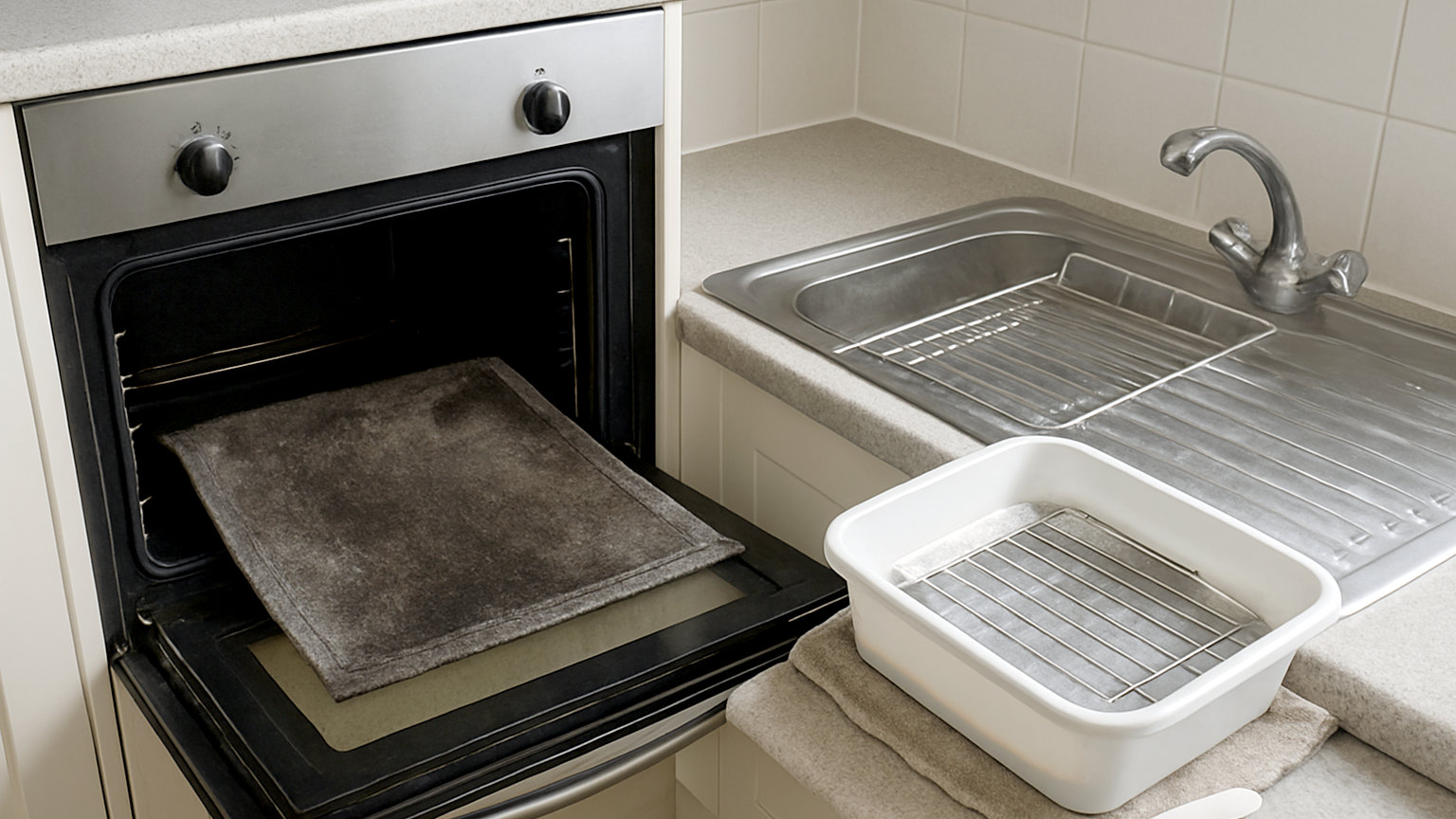
- The shelves and runners, soaked in the usual way.
- The door seal, wiped with a damp cloth only.
- The roof, if it is enamel rather than lined.
Cover or mask the liners while cleaning the base if you are using anything caustic, since overspray will damage them.
How long do they last?
Typically several years with normal use, and considerably less if the oven is used mostly at low temperatures or if a cleaner has been used on them. They can be replaced as a part, and fitting is usually a matter of a few screws.
A panel that no longer improves after repeated high temperature cycles has lost its catalytic action.
Are they worth having?
They reduce the work meaningfully rather than eliminating it, and they are considerably cheaper than a pyrolytic oven. The main risk is not knowing you have them, which is how a great many are destroyed by a well intentioned clean.
Can you fit them to an oven that lacks them?
Aftermarket catalytic panels are sold and they need to be the correct size and correctly positioned so they do not obstruct the fan or the airflow. They also only work if the oven is regularly used at 200 degrees or above. For most people the money is better spent on a decent routine, since a panel that never reaches temperature does nothing at all.