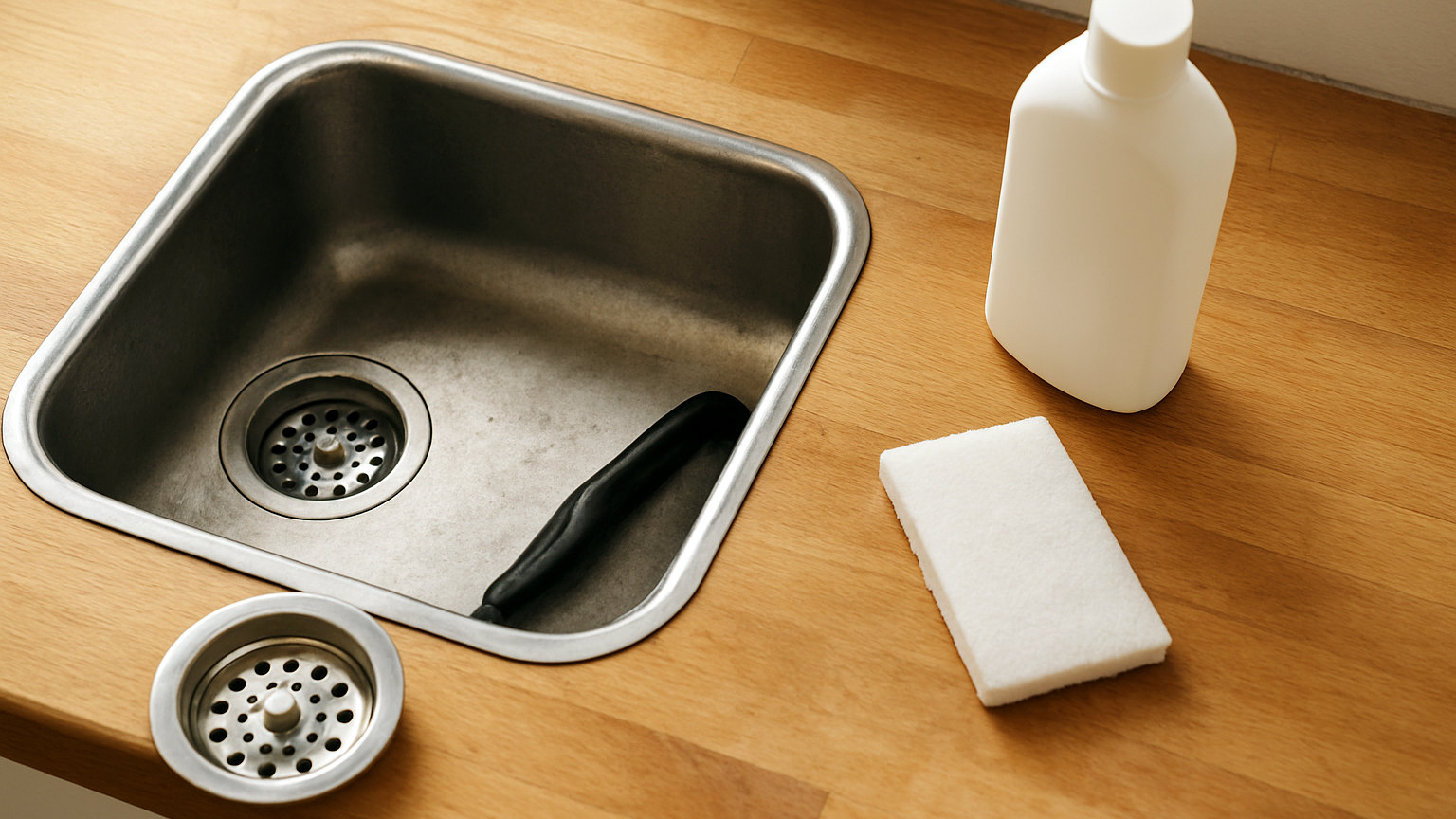
A waste disposal unit grinds food waste and sends it into the drain. The part that smells is not the grinding chamber but the underside of the rubber splash guard at the top, which collects a layer of food residue that the water and the grinding never reach.
What is the safety rule?
Never put a hand into a waste disposal unit. Even switched off, the grinding components are unpleasant to reach into and there is always a risk of the switch being operated.
Switch it off at the isolator or the wall before doing anything, and use tongs or pliers to retrieve anything dropped in.
How do you clean the splash guard?
- Switch the unit off at the wall.
- Lift the rubber splash guard out if it is removable, which it is on many units.
- Scrub both sides, particularly the underside flanges, with an old toothbrush and hot soapy water.
- If it does not come out, fold each flap upwards and scrub in place.
- Rinse and refit.
This is where the smell is, and it is the step that actually solves the problem.
How do you clean the chamber?
Run the cold tap, switch the unit on, and feed in a tray of ice cubes and a handful of coarse salt or bicarbonate of soda. The ice scours the grinding components and the salt provides abrasion.
Follow with citrus peel, which freshens and helps clear residue. Lemon, lime and orange all work.
Do this monthly, and always run the cold tap for twenty seconds after the unit stops.
Why cold water rather than hot?
Because cold water keeps fat solid so it can be ground and carried away. Hot water melts it, and it then travels down the drain and solidifies further along, which is exactly how the waste pipe blocks.
Always run cold water during and after grinding.
What should never go down one?
- Fat, oil and grease, which coat the chamber and block the drain.
- Fibrous vegetables such as celery, onion skins, corn husks and artichoke, which wrap around the components.
- Starchy foods such as pasta, rice and potato peelings, which swell and form a paste.
- Coffee grounds, which accumulate into a sludge.
- Bones, fruit stones and shells.
- Anything non-food: cutlery, bottle tops, elastic bands, cigarette ends.
- Chemical drain cleaner, which damages the components and seals.
What if it jams?
Switch it off at the wall first. Most units have a hex socket in the centre of the underside and are supplied with an allen key; turning it back and forth frees the plate.
Alternatively a broom handle can be used from above to lever the plate round, with the power off.
Once free, press the red reset button on the underside, then run cold water and test it.
What if it hums but does not turn?
That means the motor is powered but the grinding plate is jammed and cannot turn. Switch it off immediately at the wall, since leaving it running in that state will burn out the motor within a minute or two, and then free the jam using the hex key as described above before resetting it.
Is it better than composting?
It is a matter of local circumstances. A disposal unit sends food waste to the sewage system, which processes it, and it uses water and electricity. A food waste caddy collected by the council, or a compost bin, avoids both.
Where a unit is fitted, using it for scraps rather than for everything, and keeping the banned list out, is what keeps it working and the drain clear.
How do you use one properly?
Run the cold tap first, switch the unit on, then feed waste in gradually rather than tipping it all in at once, and let the unit run for twenty seconds after the grinding noise stops so that everything is flushed properly through. Switching it off the moment it sounds clear leaves residue sitting in the chamber, which is exactly where the smell starts.