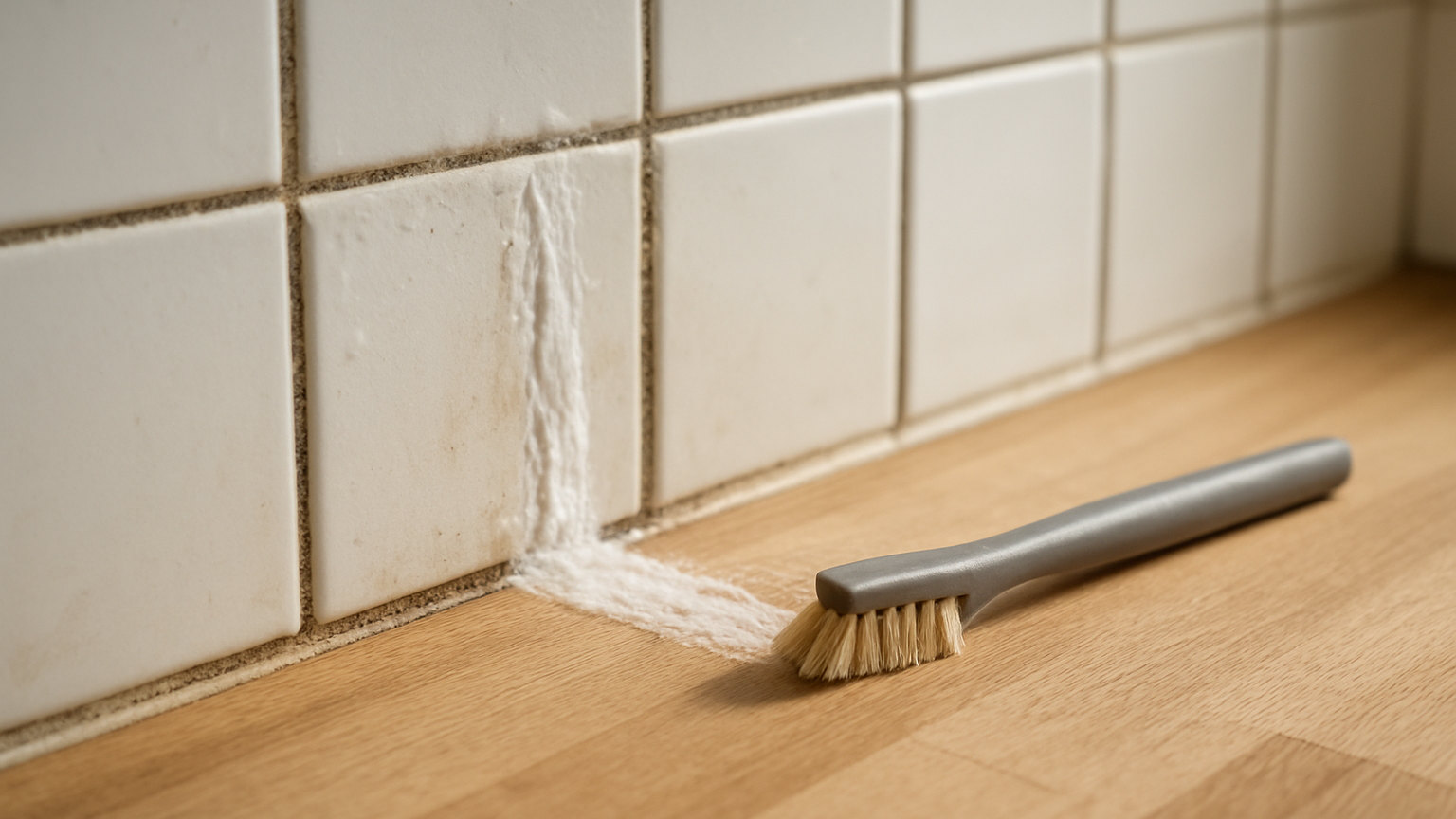
Standard cement grout is porous and absorbs water, dirt and staining. A penetrating sealer soaks into those pores and repels liquid, so spills sit on the surface long enough to be wiped away. It does not change the appearance and it makes an enormous difference to how the grout behaves.
Which grout needs sealing?
- Standard cement grout, both sanded and unsanded, which is what most homes have. Yes.
- Epoxy grout, which is non-porous. No, and it does not need it.
- Pre-sealed or stain resistant cement grouts, which still benefit from sealing eventually as the additive wears.
- Grout with natural stone tiles, where both the grout and often the stone need sealing.
How do you tell if it is sealed?
The water test. Put a few drops of water directly onto the grout line in several places and watch. If it beads and sits there, the seal is intact. If it soaks in within a minute and darkens the grout, it needs sealing.
Test in several locations, since the area around a shower or a sink wears far faster than the rest.
How do you apply a sealer?
- Clean the grout thoroughly and let it dry for at least twenty four hours, longer in a bathroom.
- Ventilate the room, since most sealers are solvent based.
- Apply the sealer along the grout lines with the applicator bottle, a small brush or a roller.
- Let it penetrate for the time on the label, usually five to fifteen minutes.
- Wipe all excess off the tile surface before it dries, which is the critical step.
- Apply a second coat if the instructions call for it.
- Keep the area dry for the stated curing time, often twenty four to forty eight hours.
Why does wiping off the excess matter?
Because sealer left on a glazed tile dries into a hazy film that is difficult to remove and may need a solvent. On a matt or textured tile it is worse, since it soaks in.
Work in small sections and wipe each one before moving on, rather than doing a whole wall and coming back.
Sealing the grout only or the whole surface?
Grout only on glazed tiles, since the tile itself needs nothing. On natural stone and unglazed porcelain, seal the whole surface with a product suitable for both, since the tile is porous too.
Applicator bottles with a wheel or a narrow nib make grout only application far quicker than a brush.
How often does it need redoing?
Annually in a shower or around a bath, where water and detergent wear it fastest. Every two to three years on a kitchen splashback or a floor. Longer in a low use area.
Use the water test rather than a calendar, since usage varies enormously.
Does sealing stop mould?
It helps considerably without eliminating it. Sealed grout does not absorb moisture, so mould has far less to establish on, and what does grow sits on the surface and wipes off. It does not prevent growth on a permanently wet surface in an unventilated room.
Ventilation and drying still matter more than any product.
Is it worth the effort?
Yes, and it is one of the better returns in household maintenance. An hour of work saves the repeated scrubbing that unsealed grout demands, and it delays the point at which regrouting becomes necessary.
What if the grout is already stained?
Clean it first and get it as good as it will go, because sealing traps whatever is in there. If cleaning has not worked, use a grout colourant instead, which seals and recolours in one application.
Does sealer wear evenly?
No, which is why the water test should be done in several places. The floor inside a shower, the splashback behind a sink and the area beside a hob all wear far faster than the rest of the same room. Those spots often need resealing when the surrounding area is still fine, and doing them alone is a five minute job.